
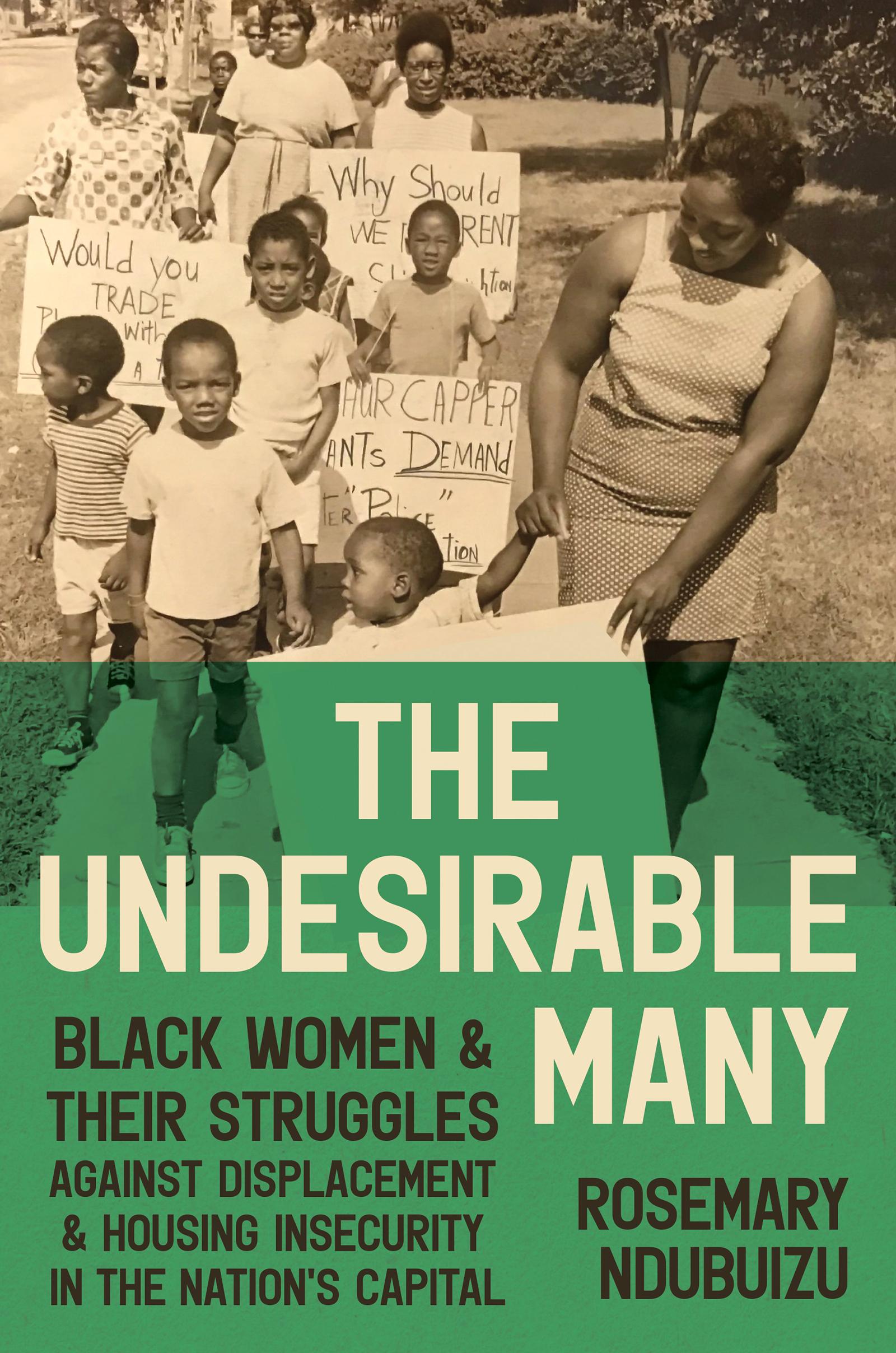
Amid a national housing affordability crisis with political and social implications, Washington, DC, is notorious for its rapidly rising income inequality, high rates of displacement, and some of the most expensive rents in the country. Housing policy expert Rosemary Ndubuizu uncovers more than 100 years of affordable housing politics in the nation’s capital to illustrate local and national trends in how various social, economic, and political forces have worked together to ensure the persistent vulnerability of low-wage Black families to housing insecurity and displacement.
Since the 1960s, Black women have been at the forefront of combating efforts to force Black people out of DC. The Undesirable Many recounts the history of Black women’s tenant activism and organized opposition through a Black feminist materialism framework that exposes present-day housing inequities as deeply entangled in the politics and practices of gender and racial inequity. Drawing on extensive archival research and dozens of in-depth interviews with Black women tenant activists and affordable housing advocates, Ndubuizu uncovers how gendered stereotypes of Black tenant irresponsibility have shaped market behavior and informed political justification for different consumer treatment. Politicians, landlords, and even nonprofit housing providers often championed disciplinary housing governance such as mandatory housekeeping classes, welfare garnishment, paternal property management, and case management, contending that the problem was not housing but the Black family itself. By exposing these strategies alongside low-income Black women’s political perspectives and experiences, The Undesirable Many offers valuable lessons for contemporary challenges in affordable housing advocacy and welfare politics.
Since the 1960s, Black women have been at the forefront of combating efforts to force Black people out of DC. The Undesirable Many recounts the history of Black women’s tenant activism and organized opposition through a Black feminist materialism framework that exposes present-day housing inequities as deeply entangled in the politics and practices of gender and racial inequity. Drawing on extensive archival research and dozens of in-depth interviews with Black women tenant activists and affordable housing advocates, Ndubuizu uncovers how gendered stereotypes of Black tenant irresponsibility have shaped market behavior and informed political justification for different consumer treatment. Politicians, landlords, and even nonprofit housing providers often championed disciplinary housing governance such as mandatory housekeeping classes, welfare garnishment, paternal property management, and case management, contending that the problem was not housing but the Black family itself. By exposing these strategies alongside low-income Black women’s political perspectives and experiences, The Undesirable Many offers valuable lessons for contemporary challenges in affordable housing advocacy and welfare politics.
Betal nemt med kort, Klarna, Apple Pay eller Google Pay. Ikke tilfreds? Du har altid 14 dages fortrydelsesret. Læs mere i vores vilkår. Har du spørgsmål, så send os en mail på hello@memmo.org.
Memmo gør det nemmere at studere – uanset hvor du er i verden. Hos os samler du dine kursusbøger og smarte studieværktøjer ét sted: resuméer, quizzer, podcasts og flashcards. Og så er der Ted, din studieven, der svarer på alt, du undrer dig over. Over 50 000 studerende studerer allerede her – bygget til at hjælpe dig med at lære hurtigere og stresse mindre.
Du kan måske også lide
Køb bogen0