
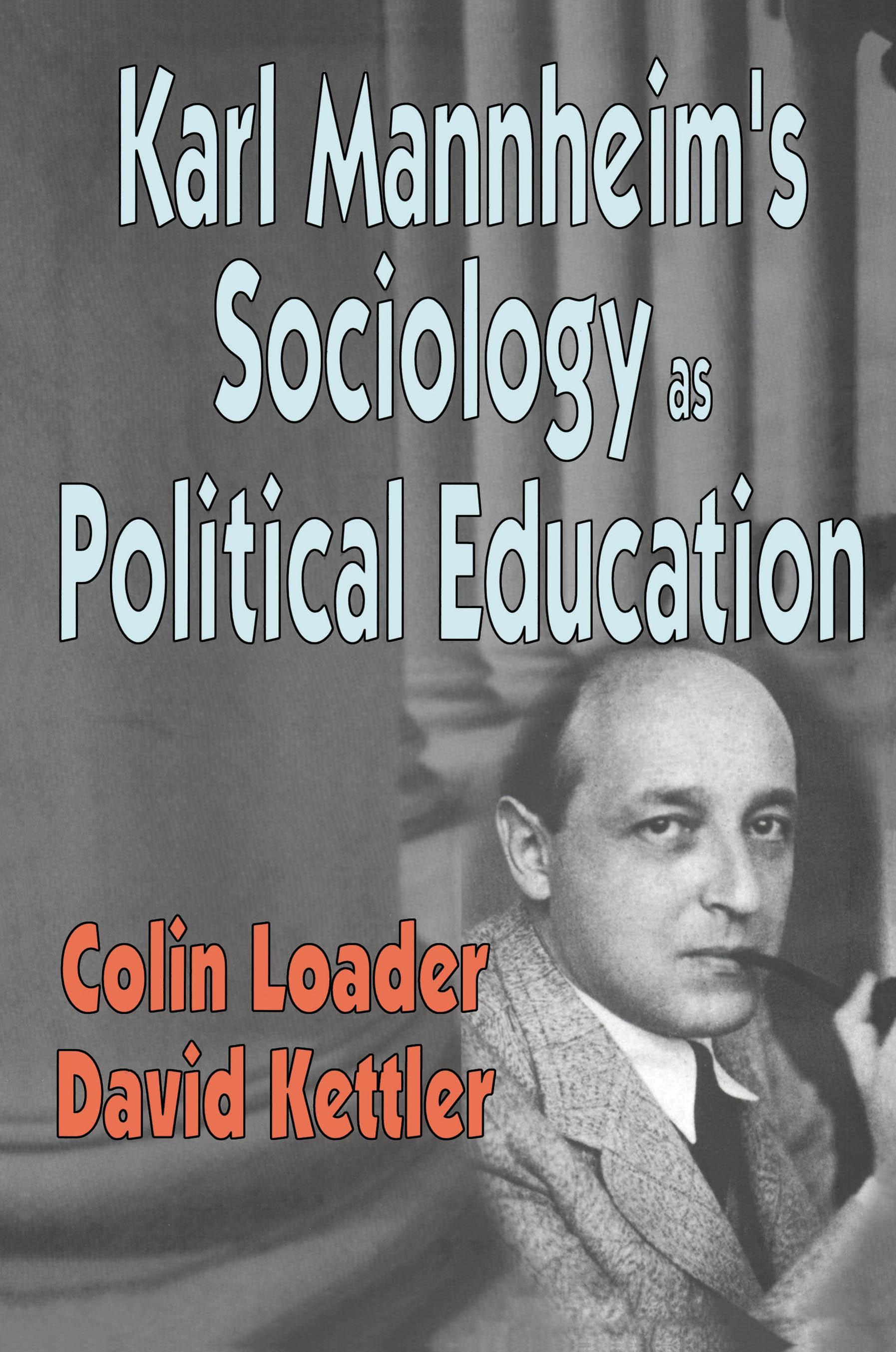
German professors and academic intellectuals are often blamed for their passivity or complicity in the face of the anti-Republican surge of the late Weimar years, culminating in the National Socialist rise to power. Karl Mannheim was a preeminent member of a vital minority committed to making German universities contribute to democratization. Mannheim argued that traditional German emphasis on the cultivation of individuals rooted in a certain high culture had to be adapted to a more egalitarian, socially complex community. He advocated teaching of sociology to create social awareness to inspire informed political judgments. Karl Mannheim's Sociology as Political Education situates Mannheim in the Weimar debates about sociology in the university. It shows how his project of political education for democracy informs his work as well as his relations with liberal, fascist, and orthodox Marxist thinkers.
In advancing his educational strategy, Mannheim had to contend, with influential figures who attacked sociology as a mere political device to undermine cultural and national values for the sake of narrow interests and partisanship. He also had to overcome the objections of fellow sociologists, who felt the discipline would prosper only if it could persuade other academics that it made no claim to educational goals beyond the reproduction of technical findings. He had to separate himself from proponents of a politicized sociology. Mannheim argued that sociology should respond to problems that actually confronted individuals in their lives, be tolerant of difference and distance, and support efforts to generate agreement rather than encourage competition. Sociological thought had to be rigorous, critical, and attentive to evidence, but also congruent with the ultimate responsibility of individuals to fashion their lives through their acts.
Karl Mannheim's Sociology as Political Education is a joint effort by two authors who have written separately on Karl Mannheim's sociological work and who write from different disciplines and traditions of commentary. The Mannheim who emerges from this volume is remarkably contemporary. In particular, he supports arguments that the threat to academic integrity is feared less in sociology than in certain areas of cultural studies. Certainly the issue of academic politicization was better understood by Mannheim in his time than it is by either side of the debate today.
Betal nemt med kort, Klarna, Apple Pay eller Google Pay. Ikke tilfreds? Du har altid 14 dages fortrydelsesret. Læs mere i vores vilkår. Har du spørgsmål, så send os en mail på hello@memmo.org.
Memmo gør det nemmere at studere – uanset hvor du er i verden. Hos os samler du dine kursusbøger og smarte studieværktøjer ét sted: resuméer, quizzer, podcasts og flashcards. Og så er der Ted, din studieven, der svarer på alt, du undrer dig over. Over 50 000 studerende studerer allerede her – bygget til at hjælpe dig med at lære hurtigere og stresse mindre.