
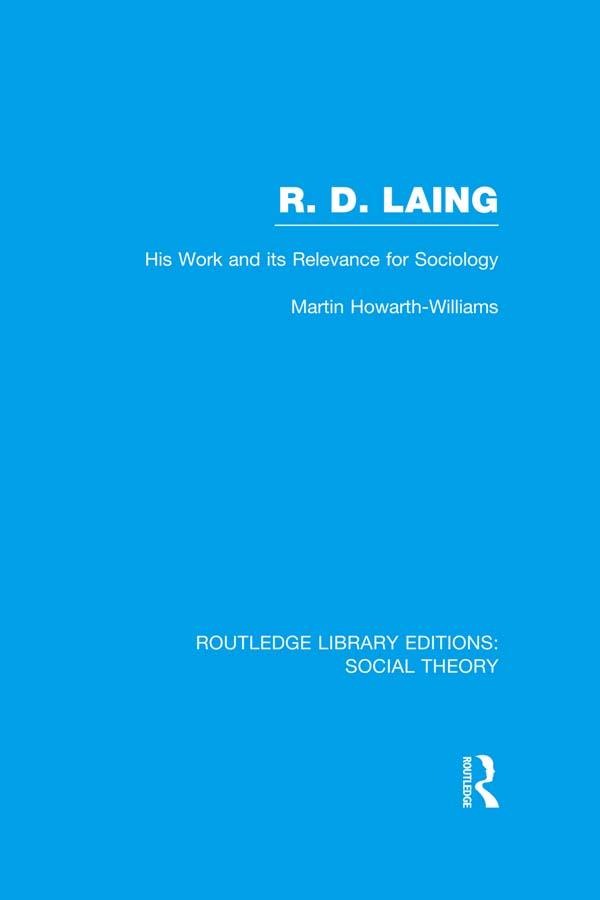
This study, by a sociologist, provides the most rigorous and comprehensive review to appear so far of R. D. Laing's work and theoretical development. Martin Howarth-Williams considers that Laing's insights into such controversial issues as the divided self and the politics of the family are of an importance that transcends their basis in clinical psychiatry and that they have a special significance for sociology. Using the Progressive/Regressive Method of Jean-Paul Sartre, the author illuminates the internal coherence of Laing's aims through the various stages of his work and shows how his ideas are shaped by consistent philosophic presuppositions and influences underlying his work.
To give as complete an account as possible of Laing's interests and to relate them to the broad stream of his thought, the author explores Laing's involvement in other non-psychiatric realms – especially politics, religion and eastern mysticism. Material has been secured from a wide variety of recent sources which include interviews, films, TV appearances and the author's own personal recollections of informal talks given by Laing.
In the final section of the book Martin Howarth-Williams isolates the concept of 'Intelligibility', which he demonstrates to be the unifying theme central to Laing's theory and shows how this can be used as the basis for a critique of recent developments in sociological theory as well as a starting point towards a genuinely dialectical sociology.
Betal nemt med kort, Klarna, Apple Pay eller Google Pay. Ikke tilfreds? Du har altid 14 dages fortrydelsesret. Læs mere i vores vilkår. Har du spørgsmål, så send os en mail på hello@memmo.org.
Memmo gør det nemmere at studere – uanset hvor du er i verden. Hos os samler du dine kursusbøger og smarte studieværktøjer ét sted: resuméer, quizzer, podcasts og flashcards. Og så er der Ted, din studieven, der svarer på alt, du undrer dig over. Over 50 000 studerende studerer allerede her – bygget til at hjælpe dig med at lære hurtigere og stresse mindre.