
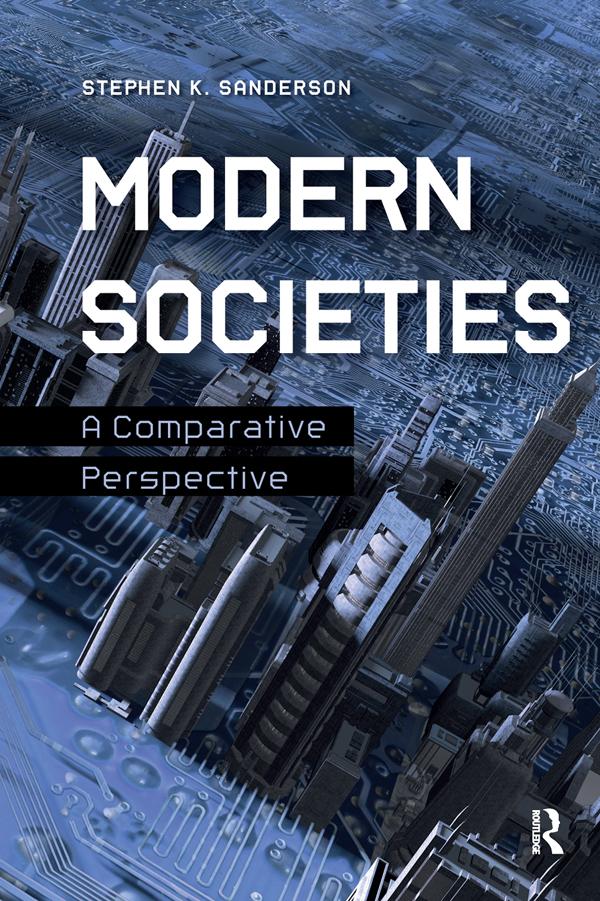
Sanderson explores the nature of the contemporary world’s 200 societies by comparing and contrasting their basic institutions and patterns of social organization. Major topics include the rich democracies and how they became rich and democratic; the expansion of government and the welfare state; the collapse of Communism and the transition to postsocialist societies; the conditions of less-developed countries, with attention to those that are developing rapidly as well as those that continue to lag far behind; racial and ethnic divisions and conflicts worldwide; the gender revolution of the past fifty years and changing contemporary patterns of gender inequality throughout the world; major shifts in family patterns and the transition to below-replacement fertility; the global spread and expansion of mass education and educational credentialism; worldwide patterns of religious belief and practice; a detailed evaluation of the secularization thesis; economic, political, and cultural globalization; the nature of social and economic progress over the past two centuries; and nine predictions concerning the short-term and long-term future of the world. The book provides detailed and fully up-to-date statistical data on societies in forty-three tables.
Betal nemt med kort, Klarna, Apple Pay eller Google Pay. Ikke tilfreds? Du har altid 14 dages fortrydelsesret. Læs mere i vores vilkår. Har du spørgsmål, så send os en mail på hello@memmo.org.
Memmo gør det nemmere at studere – uanset hvor du er i verden. Hos os samler du dine kursusbøger og smarte studieværktøjer ét sted: resuméer, quizzer, podcasts og flashcards. Og så er der Ted, din studieven, der svarer på alt, du undrer dig over. Over 50 000 studerende studerer allerede her – bygget til at hjælpe dig med at lære hurtigere og stresse mindre.