
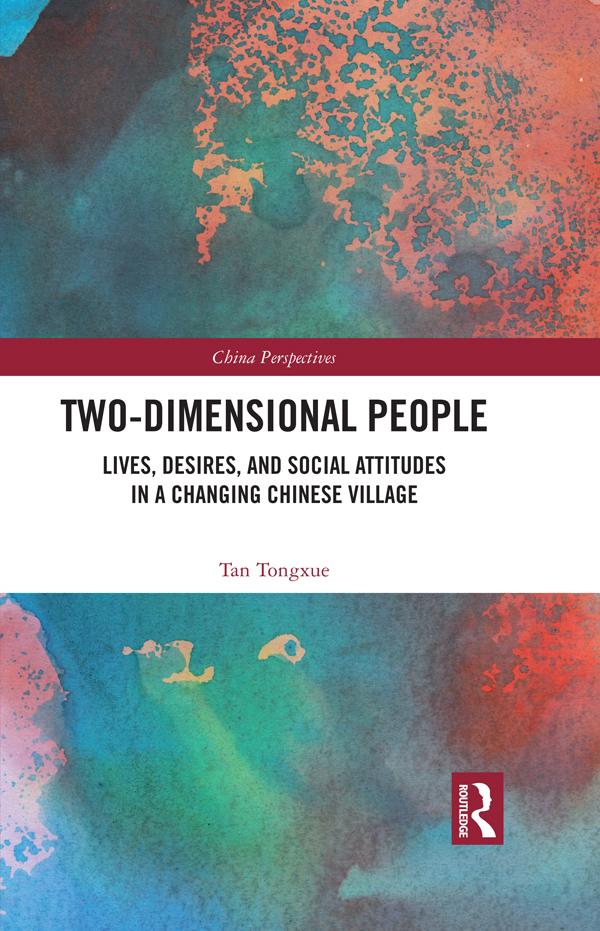
Based on almost eight years of fieldwork in a town and a village in South China, this book analyzes contradictions among various dimensions of the peasant economy, social relationships, popular religion, and local politics in rural China.
Compared to many anthropological, sociological, and political studies of rural China, which regard Chinese peasants as one-dimensionally materialistic, politically conservative, egocentric (lacking public-mindedness, as in anthropologist Yan Yunxiang’s notion of the "uncivil individual"), with collapsed beliefs, and thinking only of the present (or the "today-ness of today" according to anthropologist Liu Xin), this book shows that people in contemporary rural China are actually "two-dimensional": trying to combine the calculation of self-interest with affective networks of reciprocity, but often falling into awkwardness or cynicism, in a paradoxical symbiosis between nihilism and transcendence. While Marcuse used the words of Benjamin to analyze "one-dimensional man," writing "Only for the sake of the hopeless ones have we been given hope," this book writes of two-dimensional people, "Only when the vast majority of ordinary people can find hope in everyday life can we finally be given hope!"
This book will be of interest to scholars and students of Sociology, Anthropology and East Asian Studies. It will also be a great read to those who are interested in contemporary China in general.
Betal nemt med kort, Klarna, Apple Pay eller Google Pay. Ikke tilfreds? Du har altid 14 dages fortrydelsesret. Læs mere i vores vilkår. Har du spørgsmål, så send os en mail på hello@memmo.org.
Memmo gør det nemmere at studere – uanset hvor du er i verden. Hos os samler du dine kursusbøger og smarte studieværktøjer ét sted: resuméer, quizzer, podcasts og flashcards. Og så er der Ted, din studieven, der svarer på alt, du undrer dig over. Over 50 000 studerende studerer allerede her – bygget til at hjælpe dig med at lære hurtigere og stresse mindre.