
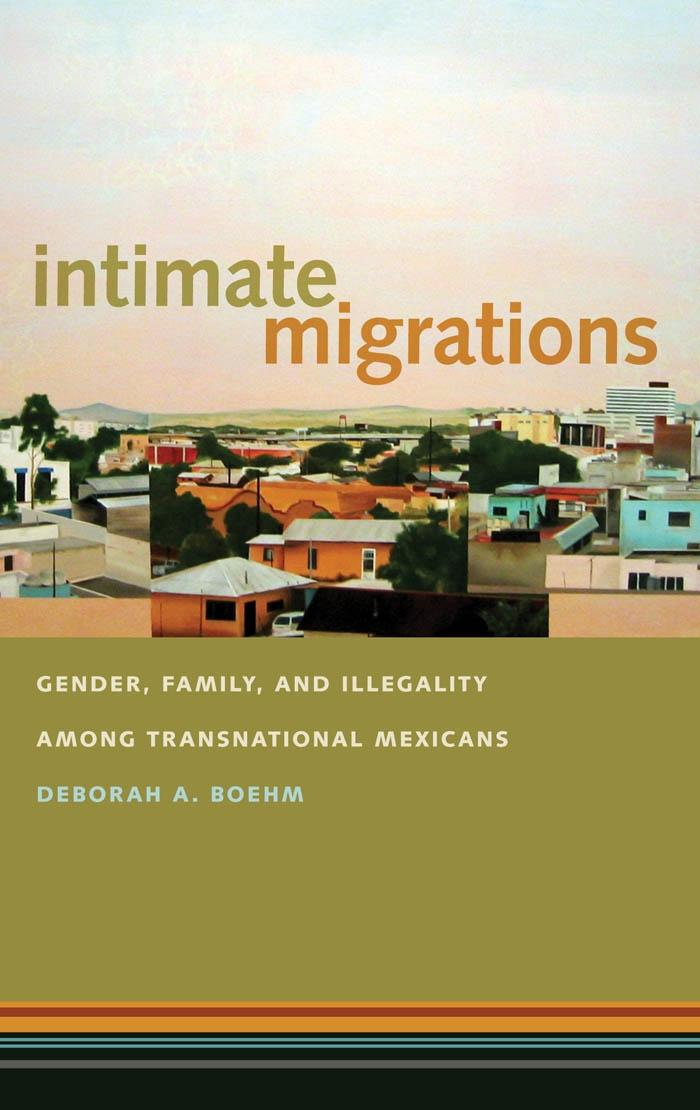
In her research with transnational Mexicans, Deborah A. Boehm has often asked individuals: if there were no barriers to your movement between Mexico and the United States, where would you choose to live? Almost always, they desire the freedom to “come and go.” Yet the barriers preventing such movement are many. Because of the United States’ rigid immigration policies, Mexican immigrants often find themselves living long distances from family members and unable to easily cross the U.S.-Mexico border. Transnational Mexicans experience what Boehm calls “intimate migrations,” flows that both shape and are structured by gendered and familial actions and interactions, but are always defined by the presence of the U.S. state.
Intimate Migrations is based on over a decade of ethnographic research, focusing on Mexican immigrants with ties to a small, rural community in the Mexican state of San Luis Potosí and several states in the U.S. West. By showing how intimate relations direct migration, and by looking at kin and gender relationships through the lens of illegality, Boehm sheds new light on the study of gender and kinship, as well as understandings of the state and transnational migration.
Betal nemt med kort, Klarna, Apple Pay eller Google Pay. Ikke tilfreds? Du har altid 14 dages fortrydelsesret. Læs mere i vores vilkår. Har du spørgsmål, så send os en mail på hello@memmo.org.
Memmo gør det nemmere at studere – uanset hvor du er i verden. Hos os samler du dine kursusbøger og smarte studieværktøjer ét sted: resuméer, quizzer, podcasts og flashcards. Og så er der Ted, din studieven, der svarer på alt, du undrer dig over. Over 50 000 studerende studerer allerede her – bygget til at hjælpe dig med at lære hurtigere og stresse mindre.