
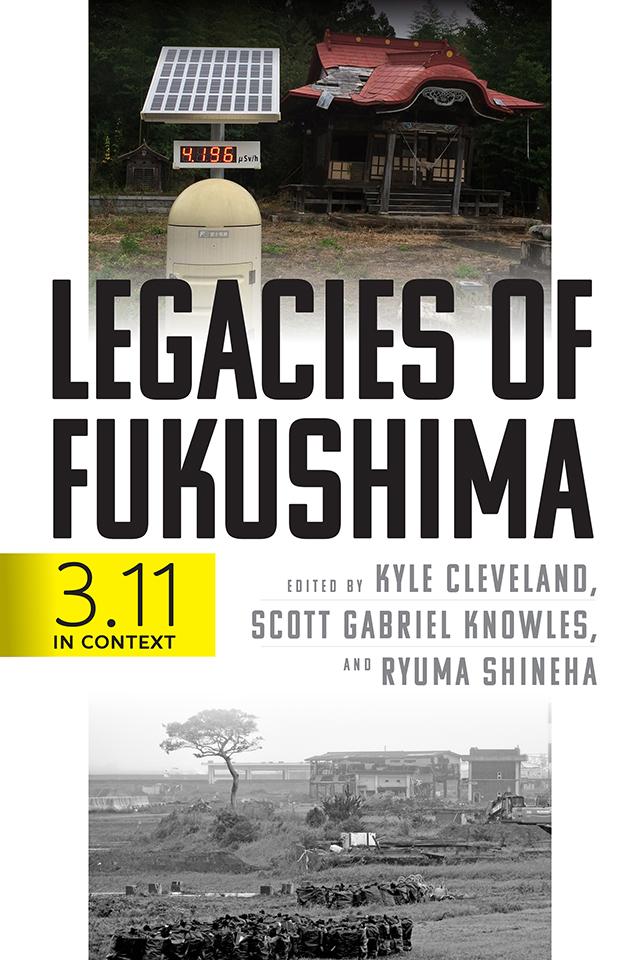
It was an unlikely convergence of events. A 9.0 magnitude earthquake, the largest in Japanese memory and the fourth largest recorded in world history; a tsunami that peaked at forty meters, devastating the seaboard of northeastern Japan; three reactors in meltdown at the Daiichi nuclear power plant in Fukushima; experts in disarray and suffering victims young and old. It was, as well, an unlikely convergence of legacies. Submerged traumas resurfaced and communities long accustomed to living quietly with hazards suddenly were heard. New legacies of disaster were handed down, unfolding slowly for generations to come.
The defining disaster of contemporary Japanese history still goes by many different names: The Great East Japan Earthquake; the 2011 Tōhoku Earthquake and Tsunami; the Fukushima Daiichi Nuclear Disaster; the 3.11 Triple Disaster. Each name represents a struggle to place the disaster on a map and fix a date to a timeline. But within each of these names hides a combination of disasters and legacies that converged on March 11, 2011, before veering away in all directions: to the past, to the future, across a nation, and around the world. Which pathways from the past will continue, which pathways ended with 3.11, and how are these legacies entangled?
Legacies of Fukushima places these questions front and center. The authors collected here contextualize 3.11 as a disaster with a long period of premonition and an uncertain future. The volume employs a critical disaster studies approach, and the authors are drawn from the realms of journalism and academia, science policy and citizen science, activism and governance—and they come from East Asia, America, and Europe. 3.11 is a Japanese legacy with global impact, and the authors and their methods reflect this diversity of experience.
Contributors: Sean Bonner, Azby Brown, Kyle Cleveland, Martin Fackler, Robert Jacobs, Paul Jobin, Kohta Juraku, Tatsuhiro Kamisato, Jeff Kingston, William J. Kinsella, Scott Gabriel Knowles, Robert Jay Lifton, Luis Felipe R. Murillo, Başak Saraç-Lesavre, Sonja D. Schmid, Ryuma Shineha, James Simms, Tatsujiro Suzuki, Ekou Yagi.
Betal nemt med kort, Klarna, Apple Pay eller Google Pay. Ikke tilfreds? Du har altid 14 dages fortrydelsesret. Læs mere i vores vilkår. Har du spørgsmål, så send os en mail på hello@memmo.org.
Memmo gør det nemmere at studere – uanset hvor du er i verden. Hos os samler du dine kursusbøger og smarte studieværktøjer ét sted: resuméer, quizzer, podcasts og flashcards. Og så er der Ted, din studieven, der svarer på alt, du undrer dig over. Over 50 000 studerende studerer allerede her – bygget til at hjælpe dig med at lære hurtigere og stresse mindre.