
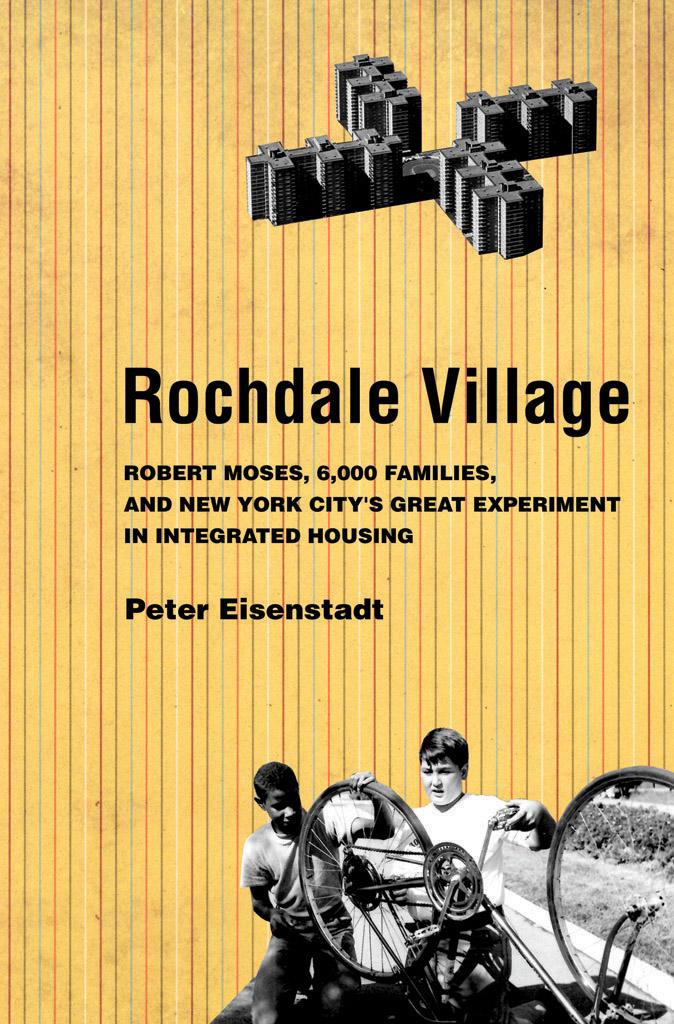
From 1963 to 1965 roughly 6,000 families moved into Rochdale Village, at the time the world's largest housing cooperative, in southeastern Queens County. The moderate-income cooperative attracted families from a diverse background, white and black, to what was a predominantly black neighborhood. In its early years, Rochdale was widely hailed as one of the few successful large-scale efforts to create an integrated community in New York City or, for that matter, anywhere in the United States.
Rochdale was built by the United Housing Foundation. Its president, Abraham Kazan, had been the major builder of low-cost cooperative housing in New York City for decades. His partner in many of these ventures was Robert Moses. Their work together was a marriage of opposites: Kazan's utopian-anarchist strain of social idealism with its roots in the early twentieth century Jewish labor movement combined with Moses's hardheaded, no-nonsense pragmatism.
Peter Eisenstadt recounts the history of Rochdale Village's first years, from the controversies over its planning, to the civil rights demonstrations at its construction site in 1963, through the late 1970s, tracing the rise and fall of integration in the cooperative. (Today, although Rochdale is no longer integrated, it remains a successful and vibrant cooperative that is a testament to the ideals of its founders and the hard work of its residents.) Rochdale's problems were a microcosm of those of the city as a whole—troubled schools, rising levels of crime, fallout from the disastrous teachers' strike of 1968, and generally heightened racial tensions. By the end of the 1970s few white families remained.
Drawing on exhaustive archival research, extensive interviews with the planners and residents, and his own childhood experiences growing up in Rochdale Village, Eisenstadt offers an insightful and engaging look at what it was like to live in Rochdale and explores the community's place in the postwar history of America's cities and in the still unfinished quests for racial equality and affordable urban housing.
Betal nemt med kort, Klarna, Apple Pay eller Google Pay. Ikke tilfreds? Du har altid 14 dages fortrydelsesret. Læs mere i vores vilkår. Har du spørgsmål, så send os en mail på hello@memmo.org.
Memmo gør det nemmere at studere – uanset hvor du er i verden. Hos os samler du dine kursusbøger og smarte studieværktøjer ét sted: resuméer, quizzer, podcasts og flashcards. Og så er der Ted, din studieven, der svarer på alt, du undrer dig over. Over 50 000 studerende studerer allerede her – bygget til at hjælpe dig med at lære hurtigere og stresse mindre.