
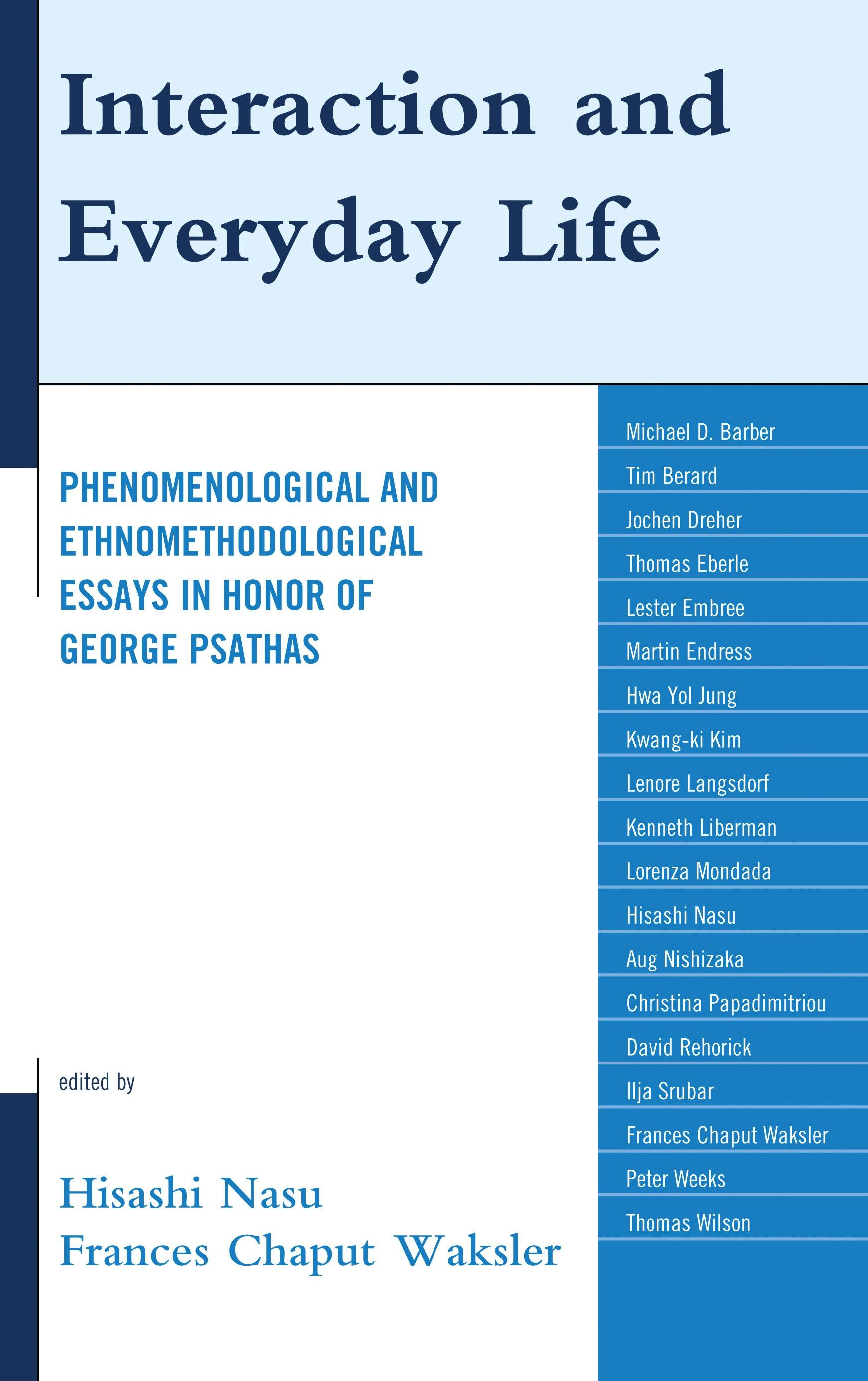
Phenomenological sociology and ethnomethodology have many adherents and practitioners throughout the world. The international character of interest in these two areas is exemplified by the scholars from Canada, France, Germany, Japan, South Korea, Switzerland, and the United States who contributed to this collection. Together they exemplify the kinds of theoretical and research issues that arise in seeking to explore the social world in ways that respect what Edmund Husserl referred to as “the original right” of all data. These chapters were inspired in various ways by the work of George Psathas, professor emeritus of Boston University, a renowned phenomenological sociologist and ethnomethodologist as well as a fundamental contributor to phenomenological sociology and ethnomethodology movements both in the United States and throughout the world. The collection consists of three parts: phenomenological sociology as an intellectual movement, phenomenological considerations, and ethnomethodological explorations, all areas to which Professor Psathas has made significant contributions.
A phenomenological sociology movement in the US is examined as an intellectual movement in itself and as it is influenced by a leader’s participation as both scholar and teacher. Phenomenological sociology’s efficacy and potential are discussed in terms of a broad range of theoretical and empirical issues: methodology, similarities and differences between phenomenological sociology and ethnomethodology, embodied sociality, power, trust, friendship, face-to-face interaction, and interactions between children and adults. Theoretical articles addressing fundamental features of ethnomethodology, its development, and its relation to process-relational philosophy are balanced by empirical articles founded on authors’ original ethnomethodological research—activities of direction-giving and direction-following, accounts for organizational deviance, garden lessons, doing being friends, and the crafting of musical time. Through these chapters readers can come to understand the theoretical development of phenomenological sociology and ethnomethodology, appreciate their achievements and their promise, and find inspiration to pursue their own work in these areas.
A phenomenological sociology movement in the US is examined as an intellectual movement in itself and as it is influenced by a leader’s participation as both scholar and teacher. Phenomenological sociology’s efficacy and potential are discussed in terms of a broad range of theoretical and empirical issues: methodology, similarities and differences between phenomenological sociology and ethnomethodology, embodied sociality, power, trust, friendship, face-to-face interaction, and interactions between children and adults. Theoretical articles addressing fundamental features of ethnomethodology, its development, and its relation to process-relational philosophy are balanced by empirical articles founded on authors’ original ethnomethodological research—activities of direction-giving and direction-following, accounts for organizational deviance, garden lessons, doing being friends, and the crafting of musical time. Through these chapters readers can come to understand the theoretical development of phenomenological sociology and ethnomethodology, appreciate their achievements and their promise, and find inspiration to pursue their own work in these areas.
Betal nemt med kort, Klarna, Apple Pay eller Google Pay. Ikke tilfreds? Du har altid 14 dages fortrydelsesret. Læs mere i vores vilkår. Har du spørgsmål, så send os en mail på hello@memmo.org.
Memmo gør det nemmere at studere – uanset hvor du er i verden. Hos os samler du dine kursusbøger og smarte studieværktøjer ét sted: resuméer, quizzer, podcasts og flashcards. Og så er der Ted, din studieven, der svarer på alt, du undrer dig over. Over 50 000 studerende studerer allerede her – bygget til at hjælpe dig med at lære hurtigere og stresse mindre.