
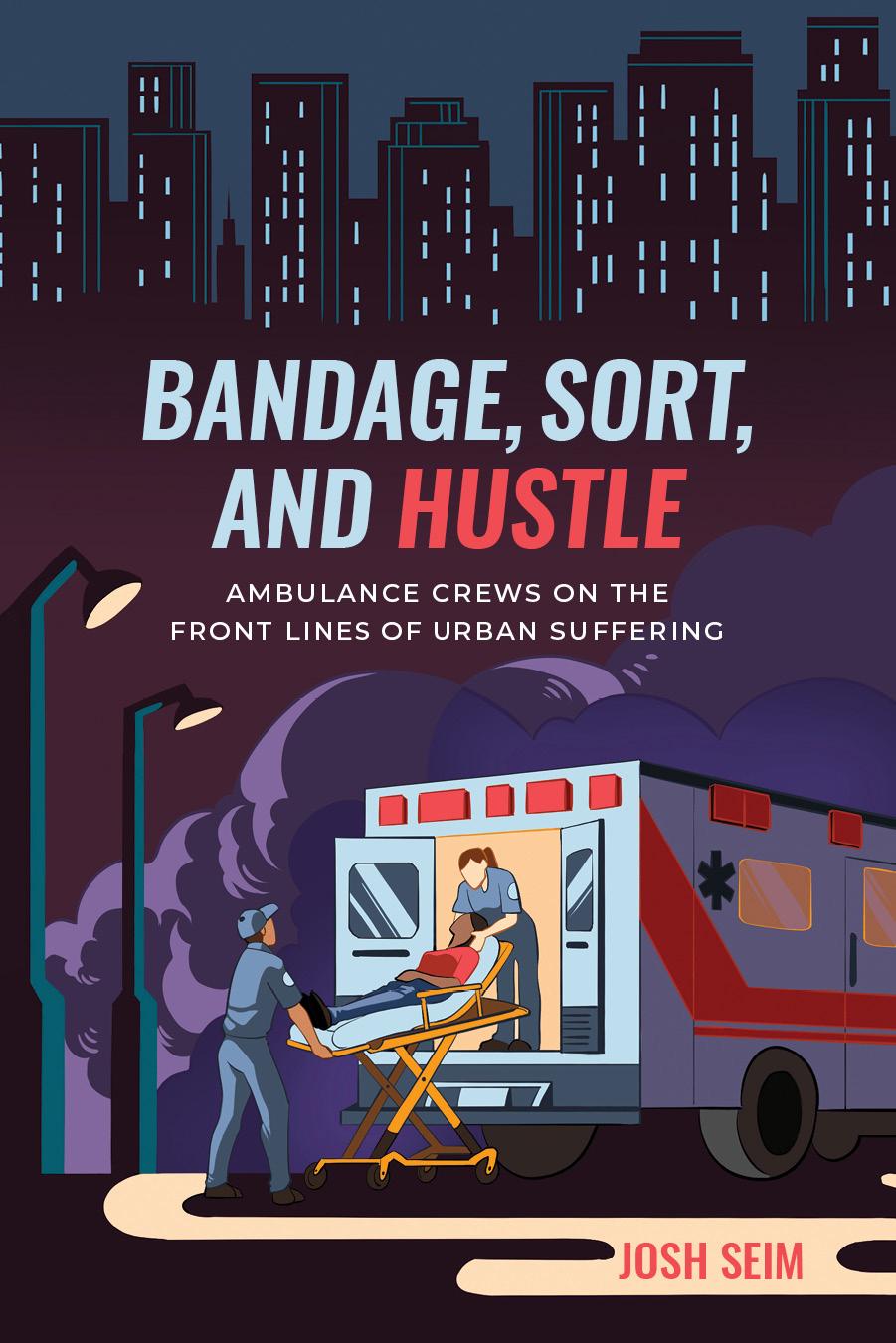
What is the role of the ambulance in the American city? The prevailing narrative provides a rather simple answer: saving and transporting the critically ill and injured. This is not an incorrect description, but it is incomplete.
Drawing on field observations, medical records, and his own experience as a novice emergency medical technician, sociologist Josh Seim reimagines paramedicine as a frontline institution for governing urban suffering. Bandage, Sort, and Hustle argues that the ambulance is part of a fragmented regime that is focused more on neutralizing hardships (which are disproportionately carried by poor people and people of color) than on eradicating the root causes of agony. Whether by compressing lifeless chests on the streets or by transporting the publicly intoxicated into the hospital, ambulance crews tend to handle suffering bodies near the bottom of the polarized metropolis.
Seim illustrates how this work puts crews in recurrent, and sometimes tense, contact with the emergency department nurses and police officers who share their clientele. These street-level relations, however, cannot be understood without considering the bureaucratic and capitalistic forces that control and coordinate ambulance labor from above. Beyond the ambulance, this book motivates a labor-centric model for understanding the frontline governance of down-and-out populations.
Drawing on field observations, medical records, and his own experience as a novice emergency medical technician, sociologist Josh Seim reimagines paramedicine as a frontline institution for governing urban suffering. Bandage, Sort, and Hustle argues that the ambulance is part of a fragmented regime that is focused more on neutralizing hardships (which are disproportionately carried by poor people and people of color) than on eradicating the root causes of agony. Whether by compressing lifeless chests on the streets or by transporting the publicly intoxicated into the hospital, ambulance crews tend to handle suffering bodies near the bottom of the polarized metropolis.
Seim illustrates how this work puts crews in recurrent, and sometimes tense, contact with the emergency department nurses and police officers who share their clientele. These street-level relations, however, cannot be understood without considering the bureaucratic and capitalistic forces that control and coordinate ambulance labor from above. Beyond the ambulance, this book motivates a labor-centric model for understanding the frontline governance of down-and-out populations.
Betal nemt med kort, Klarna, Apple Pay eller Google Pay. Ikke tilfreds? Du har altid 14 dages fortrydelsesret. Læs mere i vores vilkår. Har du spørgsmål, så send os en mail på hello@memmo.org.
Memmo gør det nemmere at studere – uanset hvor du er i verden. Hos os samler du dine kursusbøger og smarte studieværktøjer ét sted: resuméer, quizzer, podcasts og flashcards. Og så er der Ted, din studieven, der svarer på alt, du undrer dig over. Over 50 000 studerende studerer allerede her – bygget til at hjælpe dig med at lære hurtigere og stresse mindre.
Du kan måske også lide
Køb bogen0