
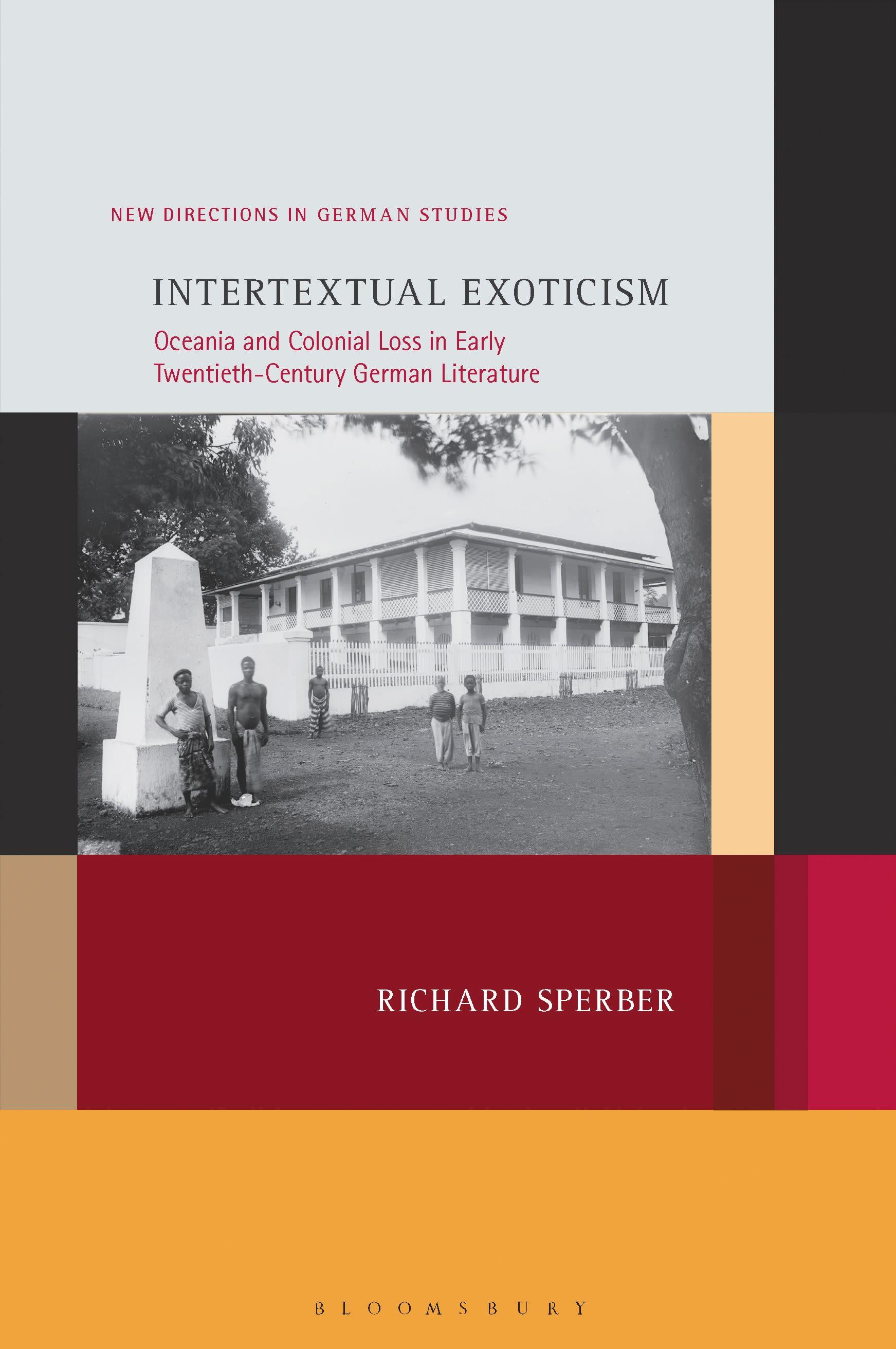
Intertextual Exoticism reads a body of non-canonical German exoticist literature published after imperial Germany's loss of colonial Oceania in 1914, applying theories of "intertextuality" (Kristeva) and recent scholarship on literary exoticism to explore Germany's postwar crises of psychology, masculinity, and national identity mapped onto Oceanic spaces.
Many readers are familiar with late Victorian texts expressing imperial Britain's anxieties. Richard Sperber expands the scope of these texts in the context of a post-imperial Europe, examining how German exoticist literature, published after German colonial loss in Oceania in 1914, intensifies the gothic themes and subjectivities of these Victorian texts.
The first part of this volume examines eight adventure narratives of Oceania, demonstrating how they do not necessarily present or represent a single, unified German colonial project. They take place on islands owned by Australia and Britain, and the unprepared German protagonists-amateur naturalists and bungling traders-are compared unfavourably to resolute Anglophone adventurers. The second part then pairs five well-known exoticist texts, including Conrad's Heart of Darkness, Stevenson's The Beach of Falesá, Haggard's She, Hitchens' The Garden of Allah, and Wilde's Salomé, with five non-canonical exoticist German texts. Sperber shows through these pairings how German literary exoticism becomes a transnational and intertextual literature that rereads dominant themes in 20th-century Europe's greater literatures of exoticism and colonial loss.
Many readers are familiar with late Victorian texts expressing imperial Britain's anxieties. Richard Sperber expands the scope of these texts in the context of a post-imperial Europe, examining how German exoticist literature, published after German colonial loss in Oceania in 1914, intensifies the gothic themes and subjectivities of these Victorian texts.
The first part of this volume examines eight adventure narratives of Oceania, demonstrating how they do not necessarily present or represent a single, unified German colonial project. They take place on islands owned by Australia and Britain, and the unprepared German protagonists-amateur naturalists and bungling traders-are compared unfavourably to resolute Anglophone adventurers. The second part then pairs five well-known exoticist texts, including Conrad's Heart of Darkness, Stevenson's The Beach of Falesá, Haggard's She, Hitchens' The Garden of Allah, and Wilde's Salomé, with five non-canonical exoticist German texts. Sperber shows through these pairings how German literary exoticism becomes a transnational and intertextual literature that rereads dominant themes in 20th-century Europe's greater literatures of exoticism and colonial loss.
Pagine: 376
Categoria: Litteraturvetenskap & Teori
e-ISBN: 9798765135495
Peso di spedizione: 1.2 kg
Spedito in: 1-2 giorni
Paga facilmente con carta, Klarna, Apple Pay o Google Pay. Non sei soddisfatto? Hai sempre 14 giorni per il rimborso. Leggi di più nei nostri termini. Per qualsiasi domanda, scrivici a hello@memmo.org.
Memmo rende lo studio più facile, ovunque tu sia nel mondo. Qui trovi i tuoi libri di testo e strumenti di studio intelligenti, tutto in un unico posto: riassunti, quiz, podcast e flashcard. E poi c'è Ted, il tuo compagno di studio che risponde a ogni tua domanda. Oltre 50.000 studenti studiano già qui: è stato creato per aiutarti a imparare più velocemente e a stressarti meno.