
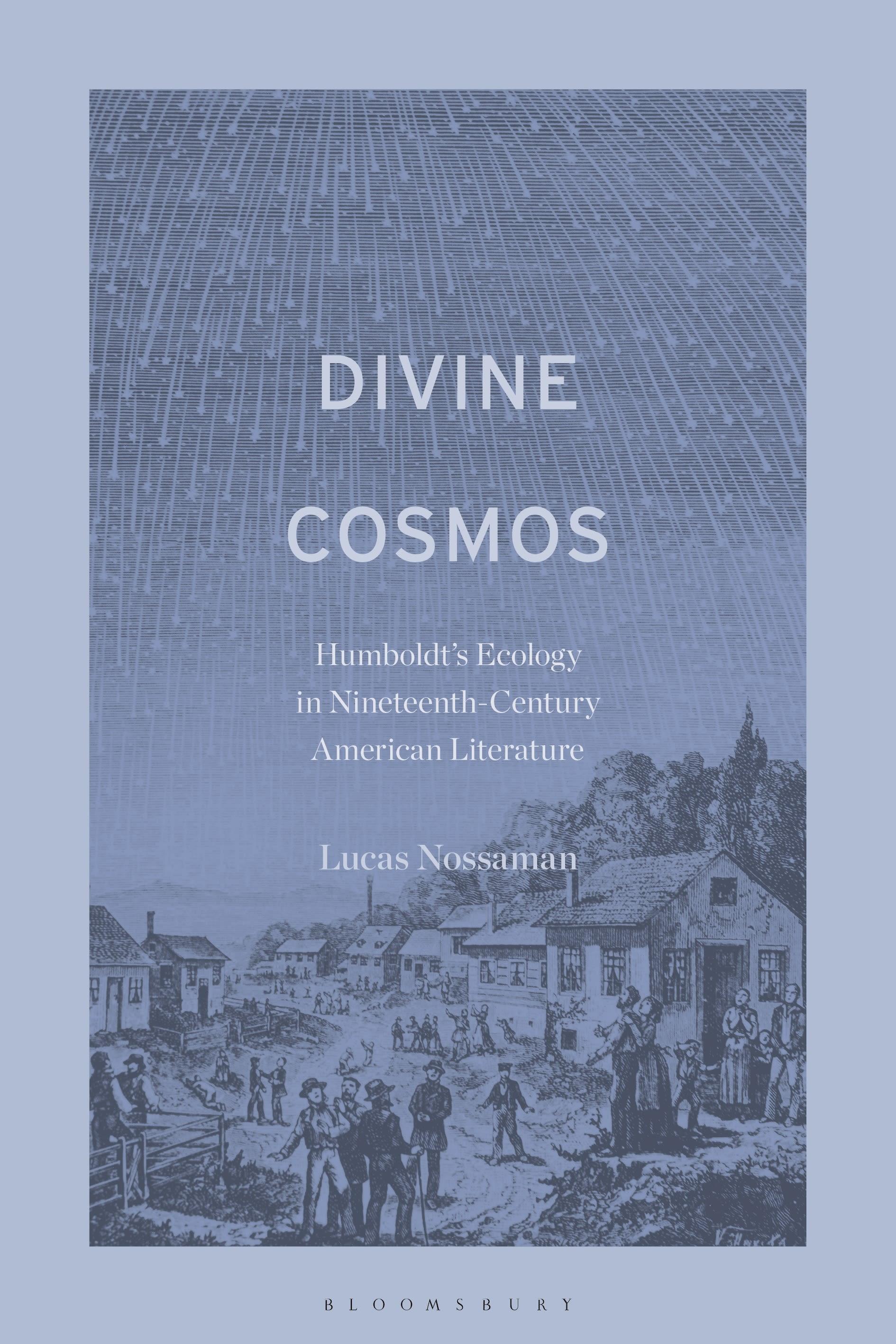
Tells the story of how 19th-century American writers re-envisioned science and religion in the age of German naturalist-explorer Alexander von Humboldt's “cosmic” ecology.
When Alexander von Humboldt began to publish the volumes of his Cosmos: A Sketch of a Physical Description of the Earth (1845–1859), Americans suddenly found themselves reimagining the natural world. Humboldt presented nature as a “cosmos,” an interconnected web that exceeded the scientific world of static taxonomy and individual species that 18th-century science had produced. As Lucas Nossaman shows, Humboldt's ecology did more than initiate a change in natural science. His writings caused Americans to reconsider how to portray the divine in nature.
Inspired by Humboldt, US scientists, theologians, and literary writers participated in what can be described as a final synthesis of science and religion before the arrival of Darwin's On the Origin of Species (1859). Writers such as Henry David Thoreau, Frederick Douglass, and Herman Melville utilized their particular religious contexts and employed Humboldtian modes of observation to envision nature holistically rather than in terms of singular evidences of “design.” They discovered that natural forms connected across regions, and indeed, across the entire divine creation.
Nossaman argues that this “Divine Cosmos” moment provides important background for later conflicts between science and religion – including the debate over evolution – and for the light it sheds on great US writings influenced by Humboldt. With implications for fields across American Studies, Divine Cosmos argues that early ecological thought transformed how Americans perceived the divine in the natural world.
When Alexander von Humboldt began to publish the volumes of his Cosmos: A Sketch of a Physical Description of the Earth (1845–1859), Americans suddenly found themselves reimagining the natural world. Humboldt presented nature as a “cosmos,” an interconnected web that exceeded the scientific world of static taxonomy and individual species that 18th-century science had produced. As Lucas Nossaman shows, Humboldt's ecology did more than initiate a change in natural science. His writings caused Americans to reconsider how to portray the divine in nature.
Inspired by Humboldt, US scientists, theologians, and literary writers participated in what can be described as a final synthesis of science and religion before the arrival of Darwin's On the Origin of Species (1859). Writers such as Henry David Thoreau, Frederick Douglass, and Herman Melville utilized their particular religious contexts and employed Humboldtian modes of observation to envision nature holistically rather than in terms of singular evidences of “design.” They discovered that natural forms connected across regions, and indeed, across the entire divine creation.
Nossaman argues that this “Divine Cosmos” moment provides important background for later conflicts between science and religion – including the debate over evolution – and for the light it sheds on great US writings influenced by Humboldt. With implications for fields across American Studies, Divine Cosmos argues that early ecological thought transformed how Americans perceived the divine in the natural world.
Paga facilmente con carta, Klarna, Apple Pay o Google Pay. Non sei soddisfatto? Hai sempre 14 giorni per il rimborso. Leggi di più nei nostri termini. Per qualsiasi domanda, scrivici a hello@memmo.org.
Memmo rende lo studio più facile, ovunque tu sia nel mondo. Qui trovi i tuoi libri di testo e strumenti di studio intelligenti, tutto in un unico posto: riassunti, quiz, podcast e flashcard. E poi c'è Ted, il tuo compagno di studio che risponde a ogni tua domanda. Oltre 50.000 studenti studiano già qui: è stato creato per aiutarti a imparare più velocemente e a stressarti meno.