
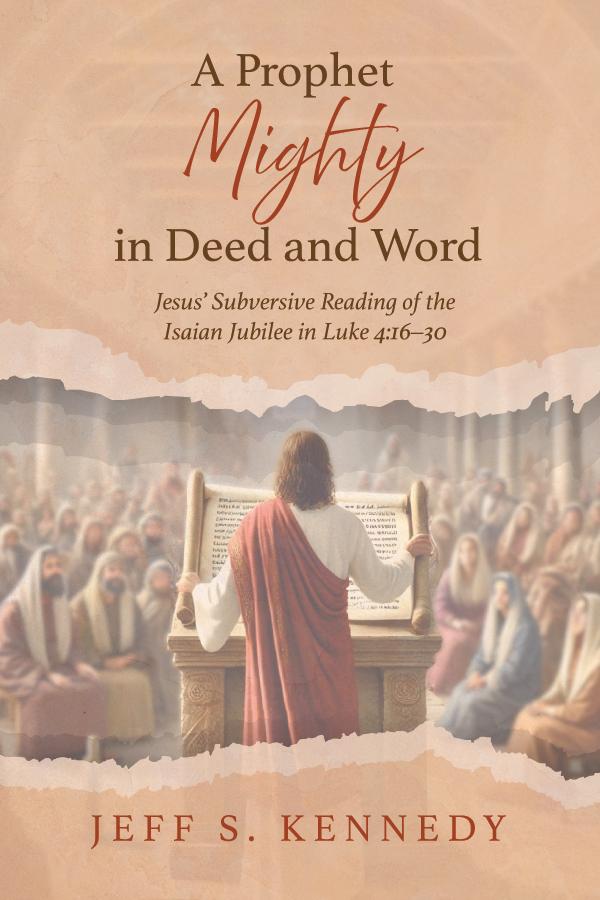
Did Jesus, the revolutionary figure who changed the world, struggle to read a scroll? A growing number of scholars think so. Luke's account of Jesus reading in the synagogue (Luke 4:16-30) is routinely challenged today in academia. The claim is that Luke either fabricated the account outright or relied upon a mistaken social memory of Jesus reading in the synagogue. Accordingly, Jesus has been recast as an illiterate peasant or semi-literate artisan unable to read and teach the way Luke portrays.
In A Prophet Mighty in Deed and Word, Jeff Kennedy offers a fresh perspective. He contends that Luke's "reading Jesus" wasn't an attempt to appeal to the cultured sensibilities of his Greek audience, who preferred literate philosophers over illiterate carpenters. Instead, it reflects Jesus' self-understanding as Israel's prophet-sage, anointed to read and proclaim the year of Yahweh's favor.
Jesus announces a shocking and provocative message for unbelieving Israel, and he does so with a singular authority. This incident sparks escalating tensions between Jesus and his countrymen, resulting in Christ's glorification through suffering. And Luke tells us that suffering began in Jesus' hometown of Nazareth.
Paga facilmente con carta, Klarna, Apple Pay o Google Pay. Non sei soddisfatto? Hai sempre 14 giorni per il rimborso. Leggi di più nei nostri termini. Per qualsiasi domanda, scrivici a hello@memmo.org.
Memmo rende lo studio più facile, ovunque tu sia nel mondo. Qui trovi i tuoi libri di testo e strumenti di studio intelligenti, tutto in un unico posto: riassunti, quiz, podcast e flashcard. E poi c'è Ted, il tuo compagno di studio che risponde a ogni tua domanda. Oltre 50.000 studenti studiano già qui: è stato creato per aiutarti a imparare più velocemente e a stressarti meno.
Potrebbe interessarti anche
Acquista il libro0