
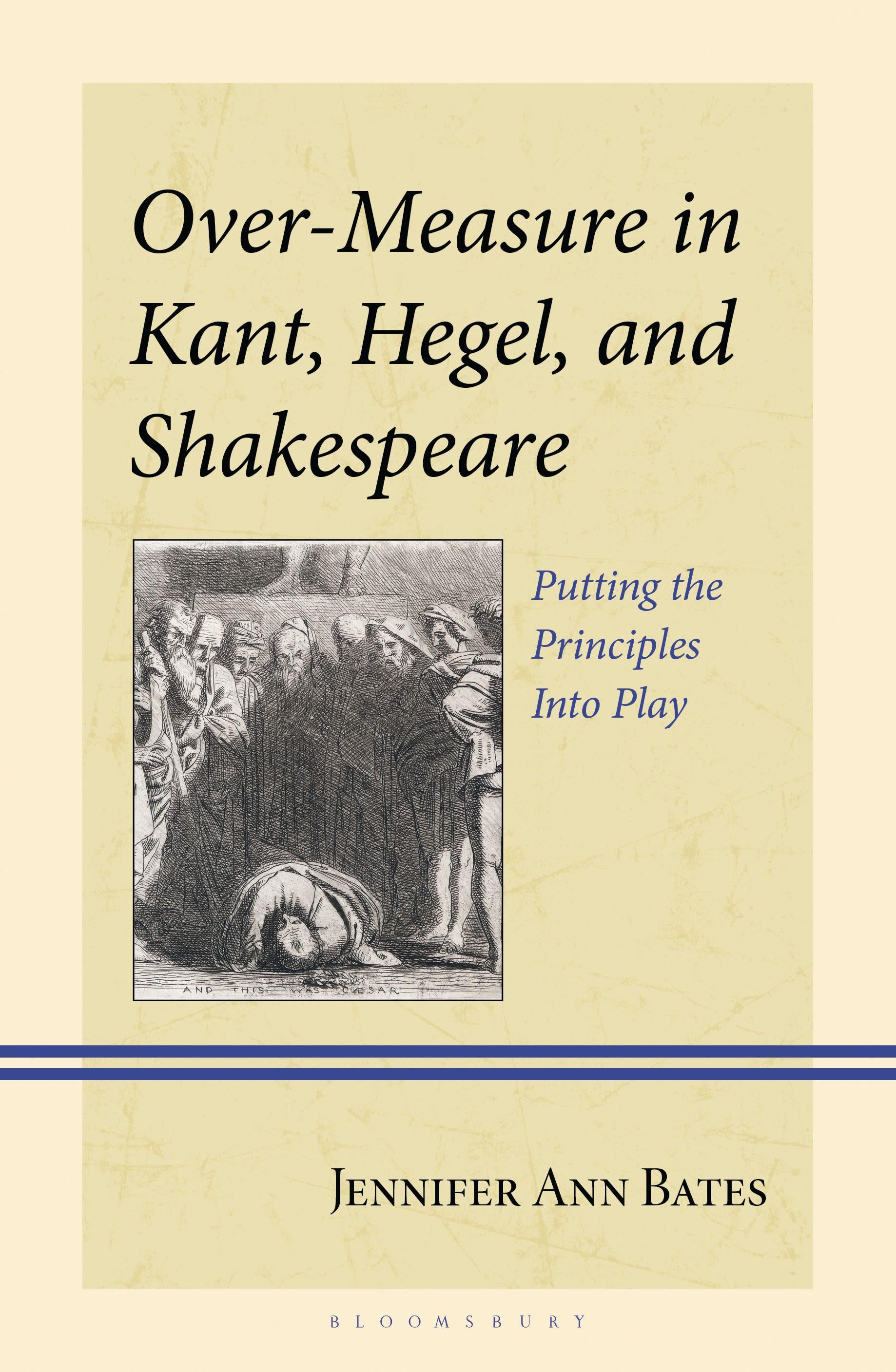
In Over-Measure in Kant, Hegel, and Shakespeare: Putting the Principles Into Play, four Shakespeare plays become the experiential-dramatic playground where operations of “principled virtues” and their informing categories are meticulously tested.
Jennifer Ann Bates begins with Hegel's logic of measure and Shakespeare's Measure for Measure, showing essential measure is indeterminable. She then combines Kant's Pure Principles of the Understanding with Shakespearean Roman tragedy, exploring principles of measure through over-measure. Bookended by Hegel's Phenomenology of Spirit, she investigates over-measures of quantity in Antony and Cleopatra, quality in Titus Andronicus, and relation and modality in Julius Caesar.
She turns to Kant for epistemic measures that make experience possible, highlighting his warnings against exceeding those limits. Putting Kant's Principles into play produces “principled virtues,” which are epistemic principles made practical and differ from Kant's Doctrine of Virtues, not just from Aristotle's virtues. Read through Shakespeare's plays, principled virtues are tragic: they miss the mark, and they are executed in both senses. The reason is that their over-measures are not grasped dialectically. The author finds a solution in Hegel's Phenomenology of Spirit, which she calls his book of over-measures. In it, Hegel reveals the necessity of overmeasures in experience, thus providing the measure for measure.
Jennifer Ann Bates begins with Hegel's logic of measure and Shakespeare's Measure for Measure, showing essential measure is indeterminable. She then combines Kant's Pure Principles of the Understanding with Shakespearean Roman tragedy, exploring principles of measure through over-measure. Bookended by Hegel's Phenomenology of Spirit, she investigates over-measures of quantity in Antony and Cleopatra, quality in Titus Andronicus, and relation and modality in Julius Caesar.
She turns to Kant for epistemic measures that make experience possible, highlighting his warnings against exceeding those limits. Putting Kant's Principles into play produces “principled virtues,” which are epistemic principles made practical and differ from Kant's Doctrine of Virtues, not just from Aristotle's virtues. Read through Shakespeare's plays, principled virtues are tragic: they miss the mark, and they are executed in both senses. The reason is that their over-measures are not grasped dialectically. The author finds a solution in Hegel's Phenomenology of Spirit, which she calls his book of over-measures. In it, Hegel reveals the necessity of overmeasures in experience, thus providing the measure for measure.
Paga facilmente con carta, Klarna, Apple Pay o Google Pay. Non sei soddisfatto? Hai sempre 14 giorni per il rimborso. Leggi di più nei nostri termini. Per qualsiasi domanda, scrivici a hello@memmo.org.
Memmo rende lo studio più facile, ovunque tu sia nel mondo. Qui trovi i tuoi libri di testo e strumenti di studio intelligenti, tutto in un unico posto: riassunti, quiz, podcast e flashcard. E poi c'è Ted, il tuo compagno di studio che risponde a ogni tua domanda. Oltre 50.000 studenti studiano già qui: è stato creato per aiutarti a imparare più velocemente e a stressarti meno.