
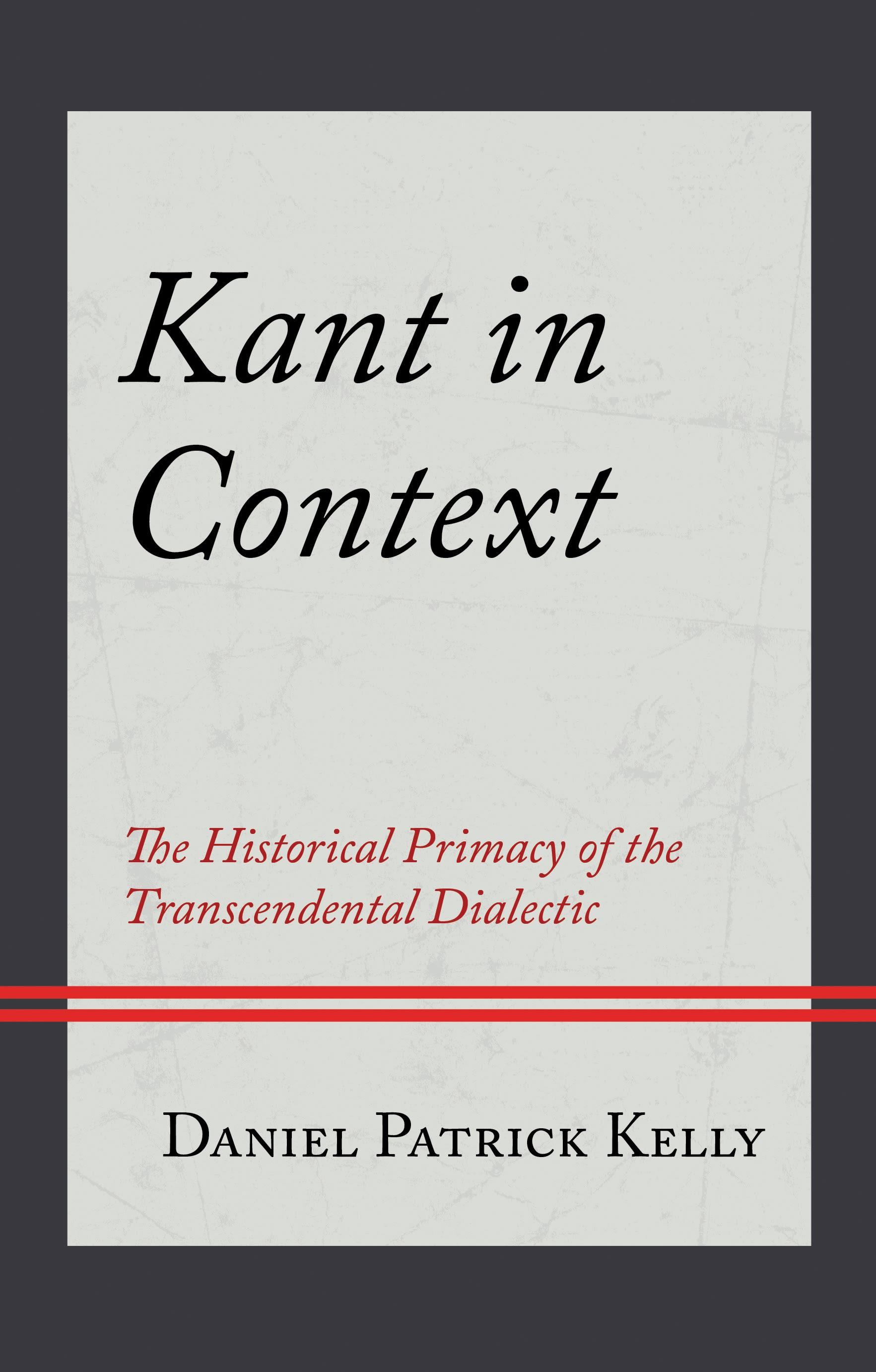
Kant in Context: The Historical Primacy of the Transcendental Dialectic examines the introduction of Kant’s critical philosophy through the lens of historical contextualization. Daniel Patrick Kelly argues that Kant’s seismic Copernican epistemic turn must be adequately positioned and understood within the German philosophical landscape that developed in Spinoza’s wake. This necessary historical analysis illuminates the development and comparative strength of Kant’s emergent transcendental idealism. However, in order to render the introduction of Kant’s critical system sufficient to this historical task, this book heuristically organizes the contents of the Critique of Pure Reason to highlight the work’s meta-philosophical historical conclusions. In this revised take on Kant’s Critique, Kelly argues that the "Transcendental Aesthetic" and subsequent "Transcendental Dialectic" emerge as foundational in understanding Kant’s Critique as a profound historical-methodological development, as they justify and ground the call for his new and supporting science of cognition, placing the "Transcendental Analytic" as inherently secondary in this heuristic reading of the Critique. The author’s overarching contention is that Kant’s identification of the dialectical limitations of metaphysical reasoning provides a more solid justification for Kant’s transcendental idealism than that of the novel postulates of the "Analytic."
Paga facilmente con carta, Klarna, Apple Pay o Google Pay. Non sei soddisfatto? Hai sempre 14 giorni per il rimborso. Leggi di più nei nostri termini. Per qualsiasi domanda, scrivici a hello@memmo.org.
Memmo rende lo studio più facile, ovunque tu sia nel mondo. Qui trovi i tuoi libri di testo e strumenti di studio intelligenti, tutto in un unico posto: riassunti, quiz, podcast e flashcard. E poi c'è Ted, il tuo compagno di studio che risponde a ogni tua domanda. Oltre 50.000 studenti studiano già qui: è stato creato per aiutarti a imparare più velocemente e a stressarti meno.