
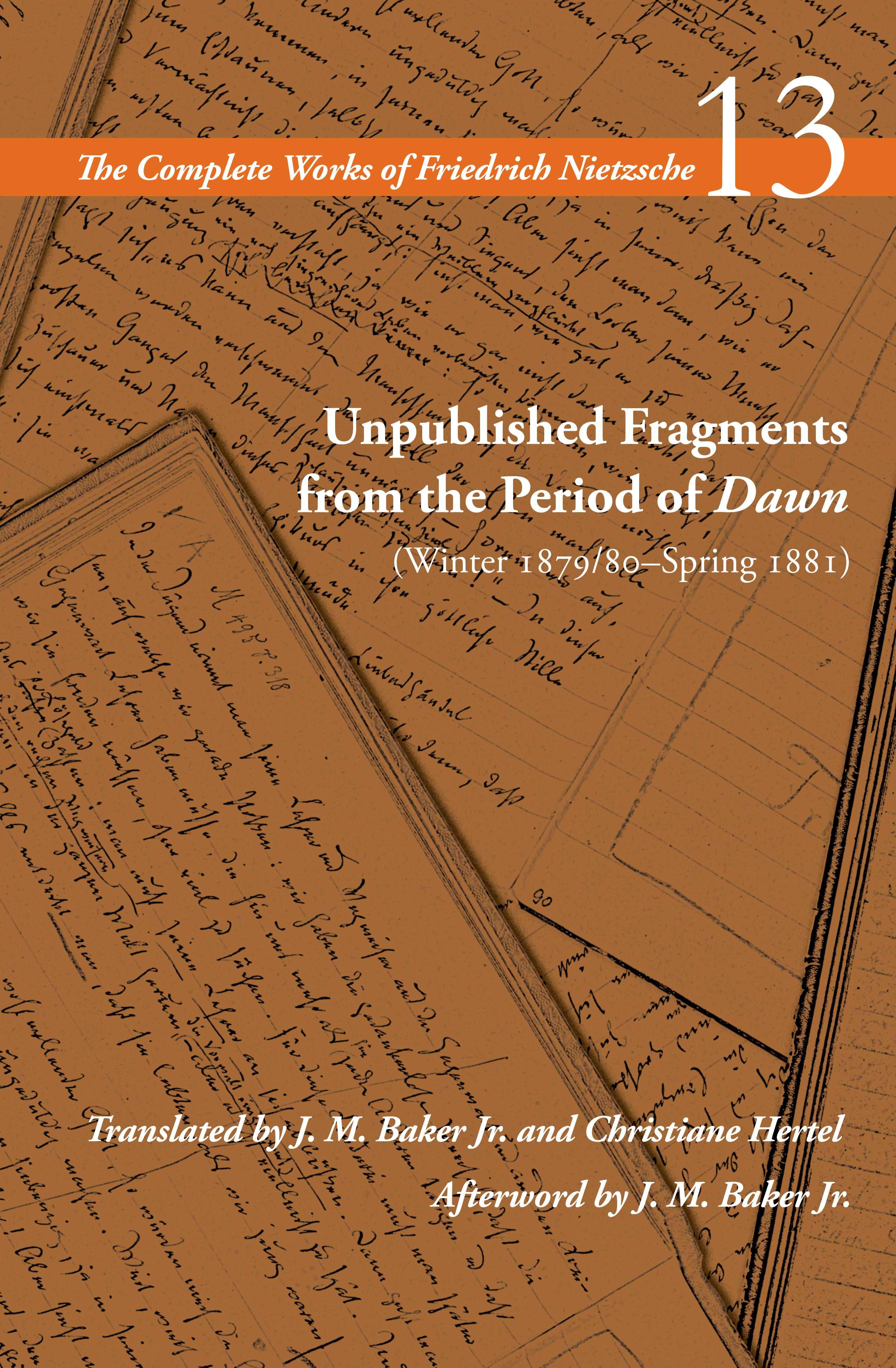
This volume provides the first English translation of Nietzsche's unpublished notes from late 1879 to early 1881, the period in which he authored Dawn, the second book in the trilogy that began with Human, All Too Human and concluded with The Joyful Science.
In these fragments, we see Nietzsche developing the conceptual triad of morals, customs, and ethics, which undergirds his critique of morality as the reification into law or dogma of conceptions of good and evil. Here, Nietzsche assesses Christianity's role in the determination of moral values as the highest values and of redemption as the representation of humanity's highest aspirations. These notes show the resulting tension between Nietzsche's contrasting thoughts on modernity, which he critiques as an unrecognized aftereffect of the Christian worldview, but also views as the springboard to "the dawn" of a transformed humanity and culture. The fragments further allow readers insight into Nietzsche's continuous internal debate with exemplary figures in his own life and culture—Napoleon, Schopenhauer, and Wagner—who represented challenges to hitherto existing morals and culture—challenges that remained exemplary for Nietzsche precisely in their failure.
Presented in Nietzsche's aphoristic style, Dawn is a book that must be read between the lines, and these fragments are an essential aid to students and scholars seeking to probe this work and its partners.
Paga facilmente con carta, Klarna, Apple Pay o Google Pay. Non sei soddisfatto? Hai sempre 14 giorni per il rimborso. Leggi di più nei nostri termini. Per qualsiasi domanda, scrivici a hello@memmo.org.
Memmo rende lo studio più facile, ovunque tu sia nel mondo. Qui trovi i tuoi libri di testo e strumenti di studio intelligenti, tutto in un unico posto: riassunti, quiz, podcast e flashcard. E poi c'è Ted, il tuo compagno di studio che risponde a ogni tua domanda. Oltre 50.000 studenti studiano già qui: è stato creato per aiutarti a imparare più velocemente e a stressarti meno.