
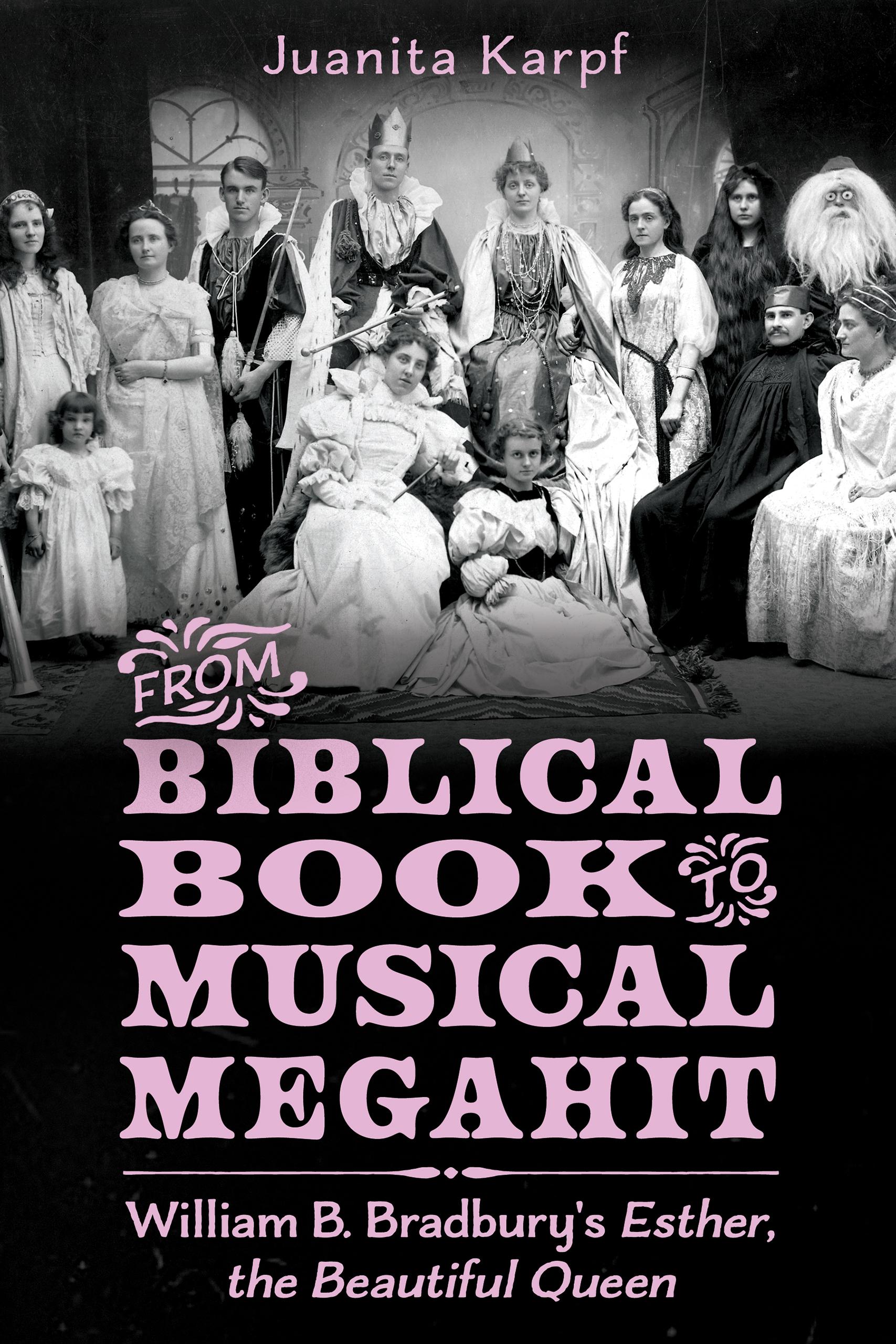
Many churchgoers will recognize the name William Bradbury, a nineteenth-century American composer of popular hymns still sung at Sunday services. Bradbury’s name may also bring to mind Esther, the Beautiful Queen, his choral setting of a text based on the biblical Book of Esther. The uncomplicated score became enormously popular almost immediately after its initial publication in 1856. In From Biblical Book to Musical Megahit: William B. Bradbury’s “Esther, the Beautiful Queen,” Juanita Karpf traces the work’s rich performance and reception history.
Bradbury emphatically stated that he intended Esther to be sung as an unadorned religious and educational piece. Yet many music directors exploited the potential for his score, producing elaborately staged events with costumes, scenery, and acting. Although directors retained Bradbury’s original music, they nonetheless facilitated Esther’s rapid entrée into the realm of music theater. This stylistic transformation ignited a firestorm of controversy. Some clergy and religiously pious citizens condemned theatrical representations of biblical texts as the epitome of debauchery, sacrilege, and sin. In contrast, more tolerant and open-minded theater enthusiasts welcomed the dramatic staging of Esther as wholesome entertainment and as evidence of a refreshingly enlightened approach to biblical interpretation.
However heated this debate seemed at times, it did little to quell the continued rise in popularity of Esther. In fact, by the late 1860s, Bradbury’s score had worked its way across the continent, north to Canada and, eventually, to Great Britain, Australia, Asia, and Africa. With performances recorded over a century after Bradbury published his score, Esther became, by any measure, an international megahit.
Bradbury emphatically stated that he intended Esther to be sung as an unadorned religious and educational piece. Yet many music directors exploited the potential for his score, producing elaborately staged events with costumes, scenery, and acting. Although directors retained Bradbury’s original music, they nonetheless facilitated Esther’s rapid entrée into the realm of music theater. This stylistic transformation ignited a firestorm of controversy. Some clergy and religiously pious citizens condemned theatrical representations of biblical texts as the epitome of debauchery, sacrilege, and sin. In contrast, more tolerant and open-minded theater enthusiasts welcomed the dramatic staging of Esther as wholesome entertainment and as evidence of a refreshingly enlightened approach to biblical interpretation.
However heated this debate seemed at times, it did little to quell the continued rise in popularity of Esther. In fact, by the late 1860s, Bradbury’s score had worked its way across the continent, north to Canada and, eventually, to Great Britain, Australia, Asia, and Africa. With performances recorded over a century after Bradbury published his score, Esther became, by any measure, an international megahit.
Pagine: 296
Categoria: Musikvetenskap
e-ISBN: 9781496848918
Peso di spedizione: 1.2 kg
Spedito in: 1-2 giorni
Paga facilmente con carta, Klarna, Apple Pay o Google Pay. Non sei soddisfatto? Hai sempre 14 giorni per il rimborso. Leggi di più nei nostri termini. Per qualsiasi domanda, scrivici a hello@memmo.org.
Memmo rende lo studio più facile, ovunque tu sia nel mondo. Qui trovi i tuoi libri di testo e strumenti di studio intelligenti, tutto in un unico posto: riassunti, quiz, podcast e flashcard. E poi c'è Ted, il tuo compagno di studio che risponde a ogni tua domanda. Oltre 50.000 studenti studiano già qui: è stato creato per aiutarti a imparare più velocemente e a stressarti meno.
Potrebbe interessarti anche
Acquista il libro0