
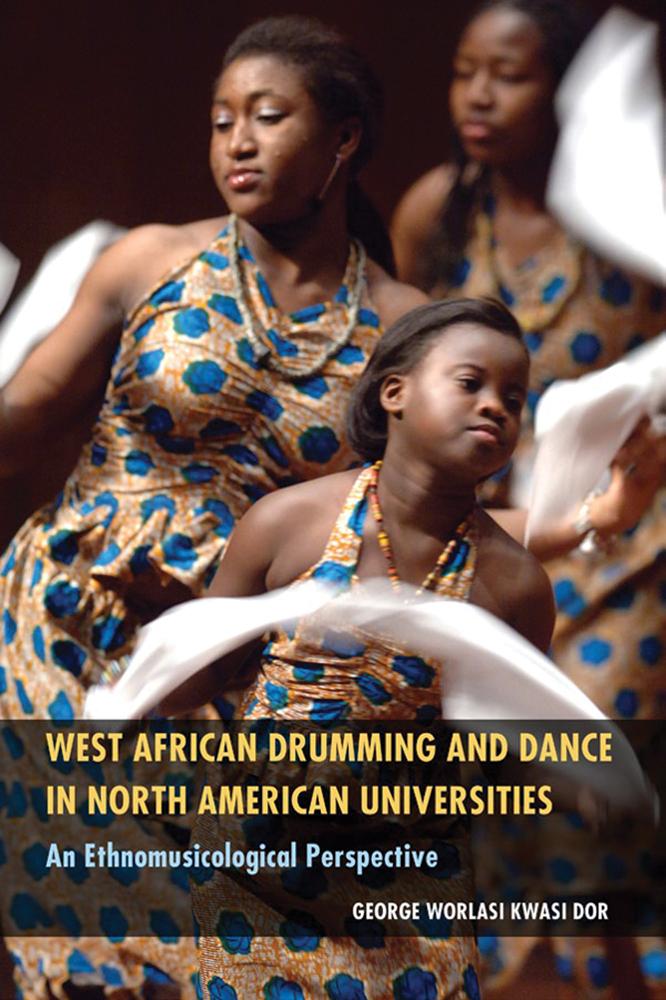
More than twenty universities and twenty other colleges in North America (USA and Canada) offer performance courses on West African ethnic dance drumming. Since its inception in 1964 at both UCLA and Columbia, West African drumming and dance has gradually developed into a vibrant campus subculture in North America. The dances most practiced in the American academy come from the ethnic groups Ewe, Akan, Ga, Dagbamba, Mande, and Wolof, thereby privileging dances mostly from Ghana, Togo, Benin, Senegal, Mali, Guinea, and Burkina Faso. This strong presence and practice of a world music ensemble in the diaspora has captured and engaged the interest of scholars, musicians, dancers, and audiences.
In the first-ever ethnographic study of West African drumming and dance in North American universities, the author documents and acknowledges ethnomusicologists, ensemble directors, students, administrators, and academic institutions for their key roles in the histories of their respective ensembles. Dor collates and shares perspectives including debates on pedagogical approaches that may be instructive as models for both current and future ensemble directors and reveals the multiple impacts that participation in an ensemble or class offers students. He also examines the interplay among historically situated structures and systems, discourse, and practice, and explores the multiple meanings that individuals and various groups of people construct from this campus activity. The study will be of value to students, directors, and scholars as an ethnographic study and as a text for teaching relevant courses in African music, African studies, ethnomusicology/world music, African diaspora studies, and other related disciplines.
In the first-ever ethnographic study of West African drumming and dance in North American universities, the author documents and acknowledges ethnomusicologists, ensemble directors, students, administrators, and academic institutions for their key roles in the histories of their respective ensembles. Dor collates and shares perspectives including debates on pedagogical approaches that may be instructive as models for both current and future ensemble directors and reveals the multiple impacts that participation in an ensemble or class offers students. He also examines the interplay among historically situated structures and systems, discourse, and practice, and explores the multiple meanings that individuals and various groups of people construct from this campus activity. The study will be of value to students, directors, and scholars as an ethnographic study and as a text for teaching relevant courses in African music, African studies, ethnomusicology/world music, African diaspora studies, and other related disciplines.
Pagine: 314
Categoria: Musikvetenskap
e-ISBN: 9781496801975
Peso di spedizione: 1.2 kg
Spedito in: 1-2 giorni
Paga facilmente con carta, Klarna, Apple Pay o Google Pay. Non sei soddisfatto? Hai sempre 14 giorni per il rimborso. Leggi di più nei nostri termini. Per qualsiasi domanda, scrivici a hello@memmo.org.
Memmo rende lo studio più facile, ovunque tu sia nel mondo. Qui trovi i tuoi libri di testo e strumenti di studio intelligenti, tutto in un unico posto: riassunti, quiz, podcast e flashcard. E poi c'è Ted, il tuo compagno di studio che risponde a ogni tua domanda. Oltre 50.000 studenti studiano già qui: è stato creato per aiutarti a imparare più velocemente e a stressarti meno.
Potrebbe interessarti anche
Acquista il libro0