
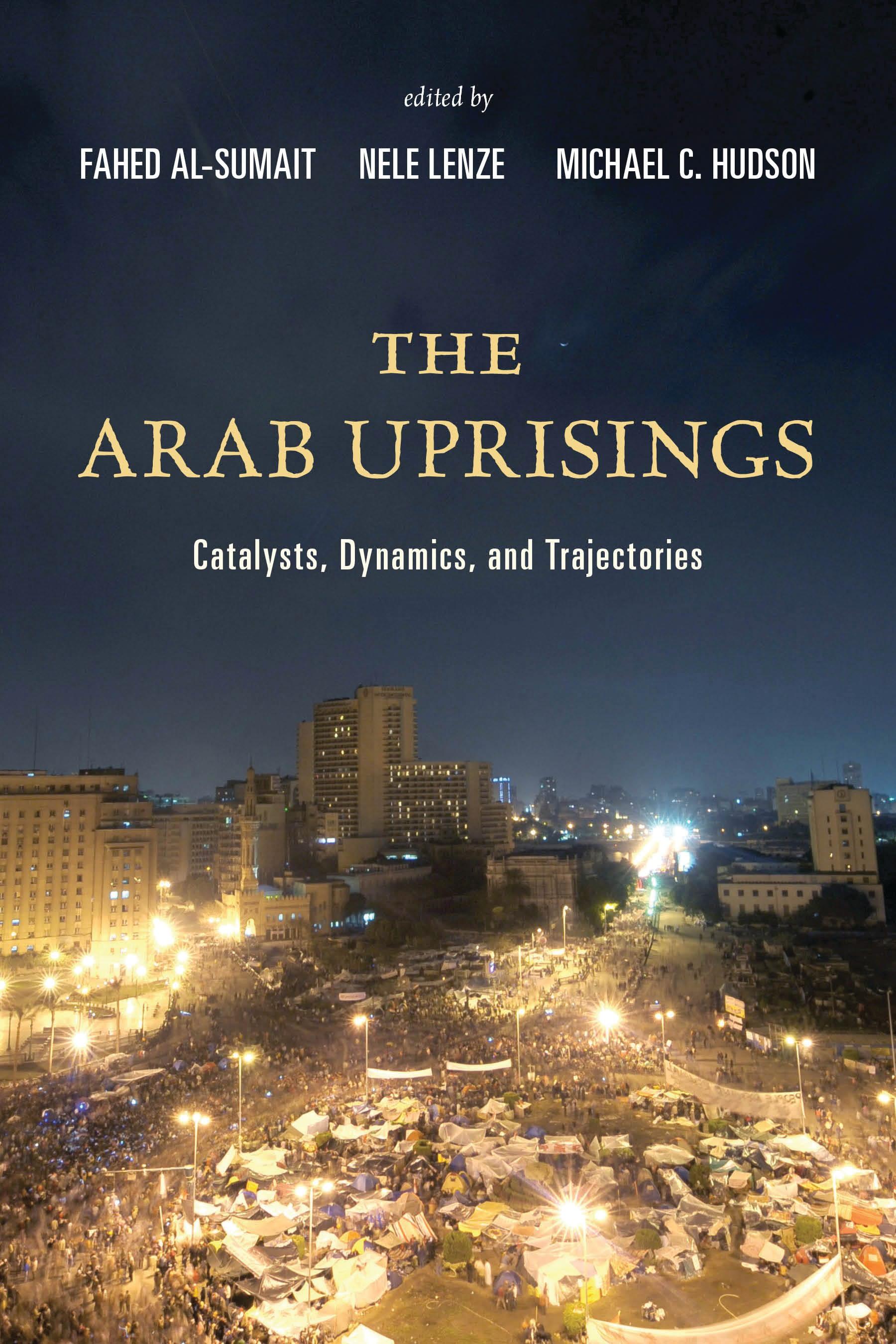
The uprisings of 2011 have radically altered the political, economic, and social landscapes of the Middle East and North Africa. A clearer view of the recent past now provides greater perspectives on the causes and the consequences of these events. This collection of essays challenges the common tendency of applying the dominant frame of “Arab Spring” to explain contemporary politics of the Middle East. Numerous debates about the utility of the “Arab Spring” metaphor already exist, contesting such issues as its foreign origins or its temporal and optimistic implications. It further has the negative and significant side effect of implying a singularity to these events in a manner that often defies the varied conditions on the ground. This is why the term “Arab Uprisings” is used here as the organizing frame to address numerous socio-cultural, economic, political, experiential, and communicative aspects of the uprisings.
This text is organized around three themes: origins, experiences, and trajectories. The first section addresses catalyzing factors that help explain the emergence of the uprisings from various political, economic, and socio-cultural perspectives. The second section examines the functions and responses of diverse people, institutions, and ideologies during the initial years of the uprisings. It includes an in-depth case study on women’s changing political situation in the catalyzing country of Tunisia, as well as discussions about the roles of political Islam, new mass media, and social networks in these rapidly changing contexts. The third section discusses cross-national implications and the multitude of repercussion the uprisings are having on the global system.
Using an interdisciplinary approach with contrasting theoretical and methodological orientations, the global experts who contributed the chapters explore various theoretical approaches, juxtaposing them with comparative surveys and in-depth case studies. They show that after the initial euphoria (or dread) that surrounded the uprisings, a transitional and transformative period in the Middle East has come that requires thorough observation and analysis.
This text is organized around three themes: origins, experiences, and trajectories. The first section addresses catalyzing factors that help explain the emergence of the uprisings from various political, economic, and socio-cultural perspectives. The second section examines the functions and responses of diverse people, institutions, and ideologies during the initial years of the uprisings. It includes an in-depth case study on women’s changing political situation in the catalyzing country of Tunisia, as well as discussions about the roles of political Islam, new mass media, and social networks in these rapidly changing contexts. The third section discusses cross-national implications and the multitude of repercussion the uprisings are having on the global system.
Using an interdisciplinary approach with contrasting theoretical and methodological orientations, the global experts who contributed the chapters explore various theoretical approaches, juxtaposing them with comparative surveys and in-depth case studies. They show that after the initial euphoria (or dread) that surrounded the uprisings, a transitional and transformative period in the Middle East has come that requires thorough observation and analysis.
Pagine: 256
Categoria: Statsvetenskap & Politik
e-ISBN: 9781442239029
Peso di spedizione: 1.2 kg
Spedito in: 1-2 giorni
Paga facilmente con carta, Klarna, Apple Pay o Google Pay. Non sei soddisfatto? Hai sempre 14 giorni per il rimborso. Leggi di più nei nostri termini. Per qualsiasi domanda, scrivici a hello@memmo.org.
Memmo rende lo studio più facile, ovunque tu sia nel mondo. Qui trovi i tuoi libri di testo e strumenti di studio intelligenti, tutto in un unico posto: riassunti, quiz, podcast e flashcard. E poi c'è Ted, il tuo compagno di studio che risponde a ogni tua domanda. Oltre 50.000 studenti studiano già qui: è stato creato per aiutarti a imparare più velocemente e a stressarti meno.