
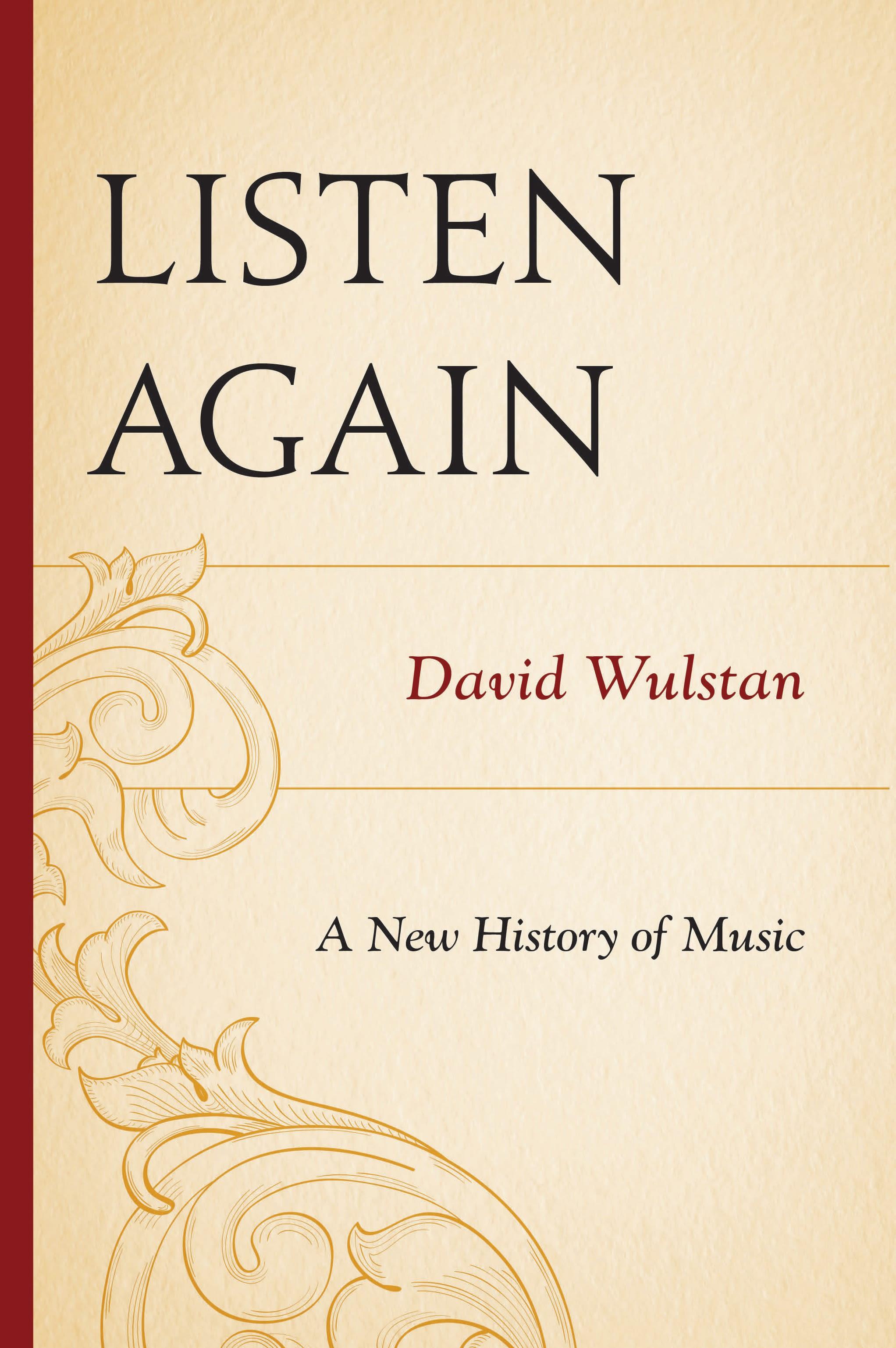
How do you tell the key of a piece—without looking at a score? How do you know when a musical work ended before an audience applauds or a radio announcer returns on air? Was there, in fact, a ‘breakdown of tonality’ in the nineteenth and twentieth centuries? These questions and others are the focus of David Wulstan’s Listen Again: A New History of Music. He also shows where the nuove musiche of the early Baroque era came from and what the two critical but unlinked chords in the middle of Bach’s Brandenburg Concerto No. III signify.
Previous literature in music does not properly address these questions and innumerable others. In Listen Again, Wulstan illustrates how music from Bach to Bartók was far less "revolutionary" than customarily imagined and that the "inversionist" doctrine of Rameau and kindred acoustical misconceptions, courtesy of Heinrich Schenker and other analysts, solve fewer problems than their purveyor claim. In Listen Again, Wulstan takes to task early theorists, who were mostly clerics who ignored non-ecclesiastical music, and their modern equivalents, who consider only the blinding white of the written or printed score, whilst ignoring music as heard and interpreted by the ear and brain. Instead, Wulstan enquires into the musical activities of the common folk to addressing key issues that early and modern theorists have regularly overlooked.
The book will appeal anyone who has dismissed "harmony," "theory" and the like as alien, in effect, to practical music. Readers will find in Listen Again that the true history of music has far more practical relevance for performers than the aridity of music theory coursework, demonstrating by example how this work a book about music, not, as in the case of so much theoretical work, a "book about books."
Previous literature in music does not properly address these questions and innumerable others. In Listen Again, Wulstan illustrates how music from Bach to Bartók was far less "revolutionary" than customarily imagined and that the "inversionist" doctrine of Rameau and kindred acoustical misconceptions, courtesy of Heinrich Schenker and other analysts, solve fewer problems than their purveyor claim. In Listen Again, Wulstan takes to task early theorists, who were mostly clerics who ignored non-ecclesiastical music, and their modern equivalents, who consider only the blinding white of the written or printed score, whilst ignoring music as heard and interpreted by the ear and brain. Instead, Wulstan enquires into the musical activities of the common folk to addressing key issues that early and modern theorists have regularly overlooked.
The book will appeal anyone who has dismissed "harmony," "theory" and the like as alien, in effect, to practical music. Readers will find in Listen Again that the true history of music has far more practical relevance for performers than the aridity of music theory coursework, demonstrating by example how this work a book about music, not, as in the case of so much theoretical work, a "book about books."
Paga facilmente con carta, Klarna, Apple Pay o Google Pay. Non sei soddisfatto? Hai sempre 14 giorni per il rimborso. Leggi di più nei nostri termini. Per qualsiasi domanda, scrivici a hello@memmo.org.
Memmo rende lo studio più facile, ovunque tu sia nel mondo. Qui trovi i tuoi libri di testo e strumenti di studio intelligenti, tutto in un unico posto: riassunti, quiz, podcast e flashcard. E poi c'è Ted, il tuo compagno di studio che risponde a ogni tua domanda. Oltre 50.000 studenti studiano già qui: è stato creato per aiutarti a imparare più velocemente e a stressarti meno.