
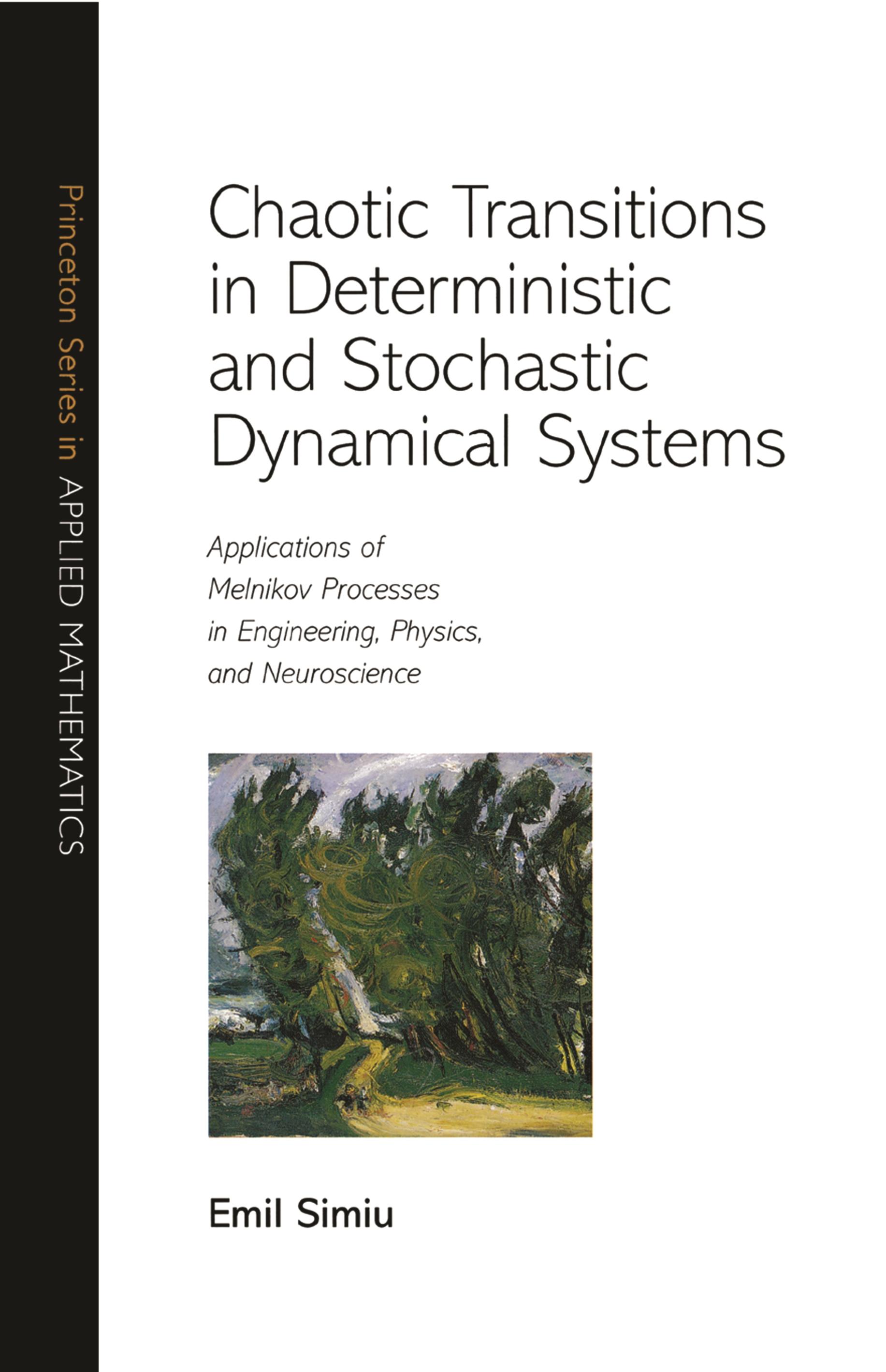
The classical Melnikov method provides information on the behavior of deterministic planar systems that may exhibit transitions, i.e. escapes from and captures into preferred regions of phase space. This book develops a unified treatment of deterministic and stochastic systems that extends the applicability of the Melnikov method to physically realizable stochastic planar systems with additive, state-dependent, white, colored, or dichotomous noise. The extended Melnikov method yields the novel result that motions with transitions are chaotic regardless of whether the excitation is deterministic or stochastic. It explains the role in the occurrence of transitions of the characteristics of the system and its deterministic or stochastic excitation, and is a powerful modeling and identification tool.
The book is designed primarily for readers interested in applications. The level of preparation required corresponds to the equivalent of a first-year graduate course in applied mathematics. No previous exposure to dynamical systems theory or the theory of stochastic processes is required. The theoretical prerequisites and developments are presented in the first part of the book. The second part of the book is devoted to applications, ranging from physics to mechanical engineering, naval architecture, oceanography, nonlinear control, stochastic resonance, and neurophysiology.
Paga facilmente con carta, Klarna, Apple Pay o Google Pay. Non sei soddisfatto? Hai sempre 14 giorni per il rimborso. Leggi di più nei nostri termini. Per qualsiasi domanda, scrivici a hello@memmo.org.
Memmo rende lo studio più facile, ovunque tu sia nel mondo. Qui trovi i tuoi libri di testo e strumenti di studio intelligenti, tutto in un unico posto: riassunti, quiz, podcast e flashcard. E poi c'è Ted, il tuo compagno di studio che risponde a ogni tua domanda. Oltre 50.000 studenti studiano già qui: è stato creato per aiutarti a imparare più velocemente e a stressarti meno.