
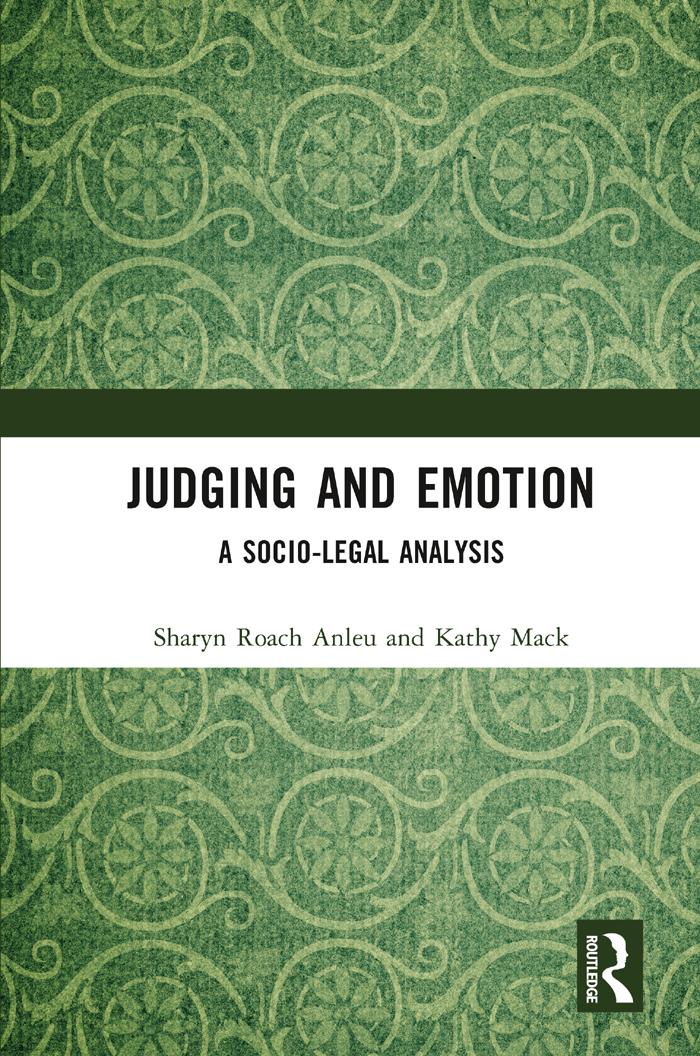
Judging and Emotion investigates how judicial officers understand, experience, display, manage and deploy emotions in their everyday work, in light of their fundamental commitment to impartiality.
Judging and Emotion challenges the conventional assumption that emotion is inherently unpredictable, stressful or a personal quality inconsistent with impartiality. Extensive empirical research with Australian judicial officers demonstrates the ways emotion, emotional capacities and emotion work are integral to judicial practice. Judging and Emotion articulates a broader conception of emotion, as a social practice emerging from interaction, and demonstrates how judicial officers undertake emotion work and use emotion as a resource to achieve impartiality. A key insight is that institutional requirements, including conceptions of impartiality as dispassion, do not completely determine the emotion dimensions of judicial work. Through their everyday work, judicial officers construct and maintain the boundaries of an impartial judicial role which necessarily incorporates emotion and emotion work.
Building on a growing interest in emotion in law and social sciences, this book will be of considerable importance to socio-legal scholars, sociologists, the judiciary, legal practitioners and all users of the courts.
Paga facilmente con carta, Klarna, Apple Pay o Google Pay. Non sei soddisfatto? Hai sempre 14 giorni per il rimborso. Leggi di più nei nostri termini. Per qualsiasi domanda, scrivici a hello@memmo.org.
Memmo rende lo studio più facile, ovunque tu sia nel mondo. Qui trovi i tuoi libri di testo e strumenti di studio intelligenti, tutto in un unico posto: riassunti, quiz, podcast e flashcard. E poi c'è Ted, il tuo compagno di studio che risponde a ogni tua domanda. Oltre 50.000 studenti studiano già qui: è stato creato per aiutarti a imparare più velocemente e a stressarti meno.