
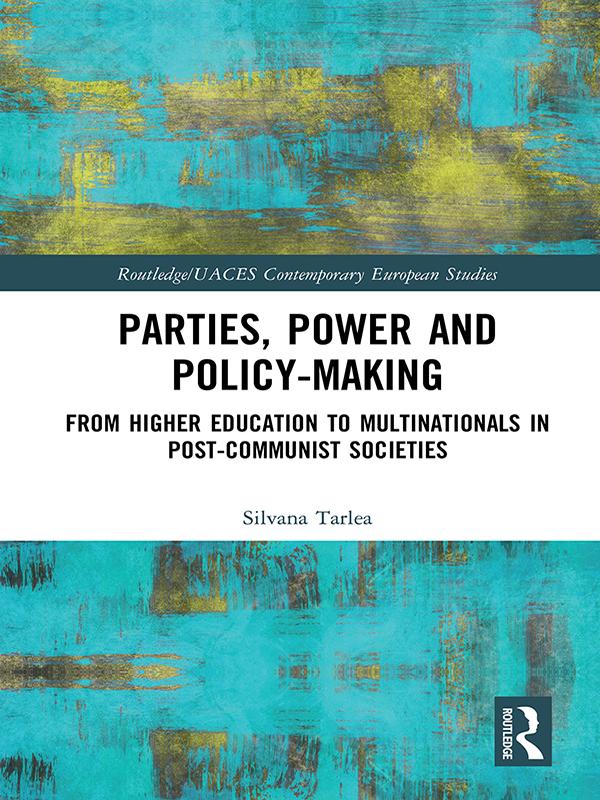
This book explains the conditions under which political parties in government were able to influence economic growth in post-communist European countries. It highlights higher education and international investment as the two essentially related areas that have been steered by governments.
The book illustrates how these countries have become reliant on multinational companies (MNCs), given their governments’ strategy to attract foreign capital, how political and economic factors are intertwined and how political parties in power can have a strong influence on the growth prospects of these economies. Furthermore, it illuminates the extent to which political parties use their space for manoeuvres when enacting policies and how they respond to their constituencies when doing so. It shows how structural conditions such as the dependence on MNCs influence policies, and how this pattern varies across Central and Eastern Europe. The book brings political parties back into the discussion on political economy and back into the analyses of welfare politics, varieties of capitalism, and democratic capitalism.
This text will be of key interest to scholars and students of comparative politics and comparative political economy, European policy-making, Central and Eastern Europe, trade, welfare and development, and higher education.
Paga facilmente con carta, Klarna, Apple Pay o Google Pay. Non sei soddisfatto? Hai sempre 14 giorni per il rimborso. Leggi di più nei nostri termini. Per qualsiasi domanda, scrivici a hello@memmo.org.
Memmo rende lo studio più facile, ovunque tu sia nel mondo. Qui trovi i tuoi libri di testo e strumenti di studio intelligenti, tutto in un unico posto: riassunti, quiz, podcast e flashcard. E poi c'è Ted, il tuo compagno di studio che risponde a ogni tua domanda. Oltre 50.000 studenti studiano già qui: è stato creato per aiutarti a imparare più velocemente e a stressarti meno.