
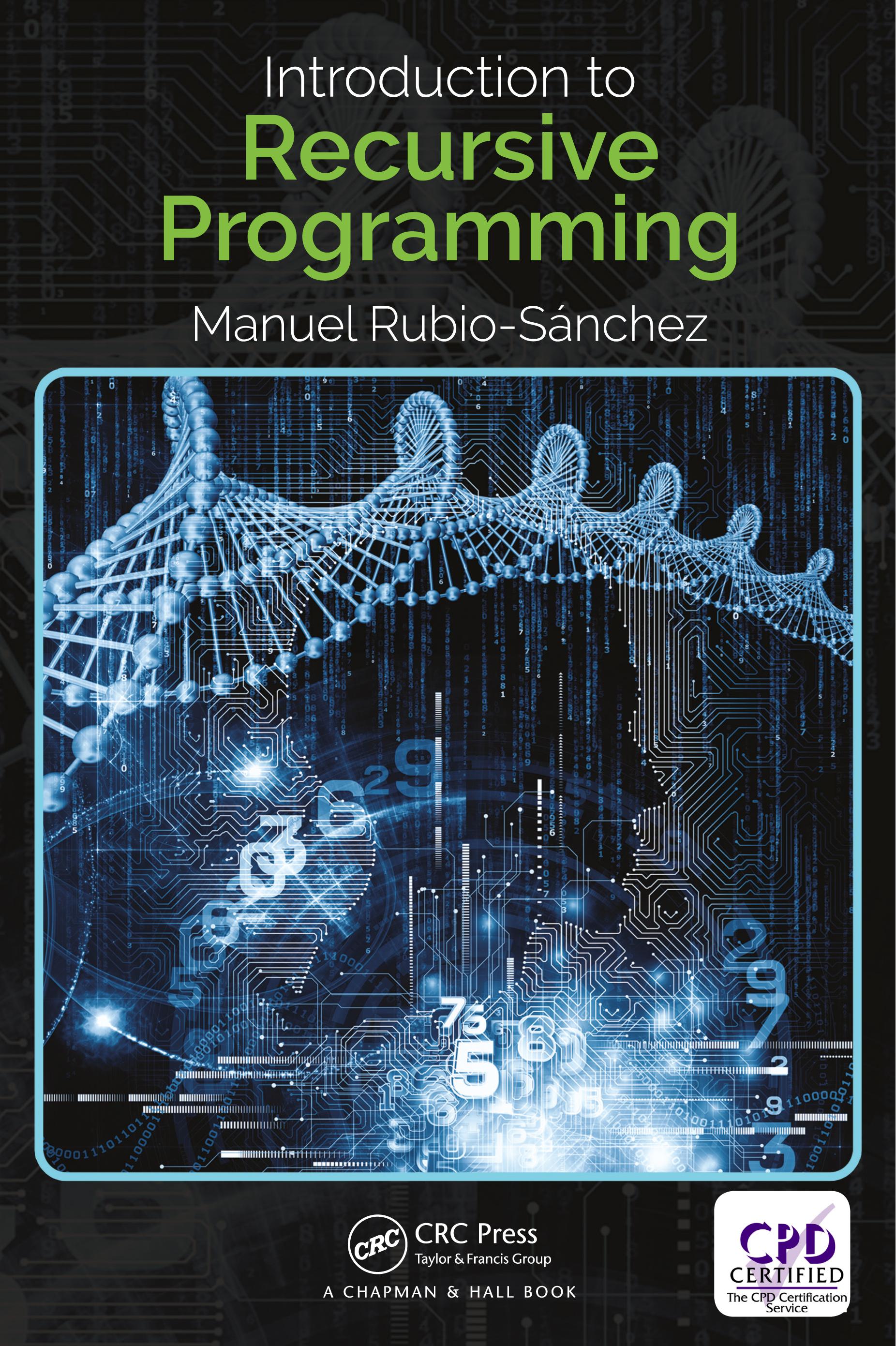
Recursion is one of the most fundamental concepts in computer science and a key programming technique that allows computations to be carried out repeatedly. Despite the importance of recursion for algorithm design, most programming books do not cover the topic in detail, despite the fact that numerous computer programming professors and researchers in the field of computer science education agree that recursion is difficult for novice students.
Introduction to Recursive Programming provides a detailed and comprehensive introduction to recursion. This text will serve as a useful guide for anyone who wants to learn how to think and program recursively, by analyzing a wide variety of computational problems of diverse difficulty.
It contains specific chapters on the most common types of recursion (linear, tail, and multiple), as well as on algorithm design paradigms in which recursion is prevalent (divide and conquer, and backtracking). Therefore, it can be used in introductory programming courses, and in more advanced classes on algorithm design. The book also covers lower-level topics related to iteration and program execution, and includes a rich chapter on the theoretical analysis of the computational cost of recursive programs, offering readers the possibility to learn some basic mathematics along the way.
It also incorporates several elements aimed at helping students master the material. First, it contains a larger collection of simple problems in order to provide a solid foundation of the core concepts, before diving into more complex material. In addition, one of the book's main assets is the use of a step-by-step methodology, together with specially designed diagrams, for guiding and illustrating the process of developing recursive algorithms. Furthermore, the book covers combinatorial problems and mutual recursion. These topics can broaden students' understanding of recursion by forcing them to apply the learned concepts differently, or in a more sophisticated manner.
The code examples have been written in Python 3, but should be straightforward to understand for students with experience in other programming languages. Finally, worked out solutions to over 120 end-of-chapter exercises are available for instructors.
Paga facilmente con carta, Klarna, Apple Pay o Google Pay. Non sei soddisfatto? Hai sempre 14 giorni per il rimborso. Leggi di più nei nostri termini. Per qualsiasi domanda, scrivici a hello@memmo.org.
Memmo rende lo studio più facile, ovunque tu sia nel mondo. Qui trovi i tuoi libri di testo e strumenti di studio intelligenti, tutto in un unico posto: riassunti, quiz, podcast e flashcard. E poi c'è Ted, il tuo compagno di studio che risponde a ogni tua domanda. Oltre 50.000 studenti studiano già qui: è stato creato per aiutarti a imparare più velocemente e a stressarti meno.