
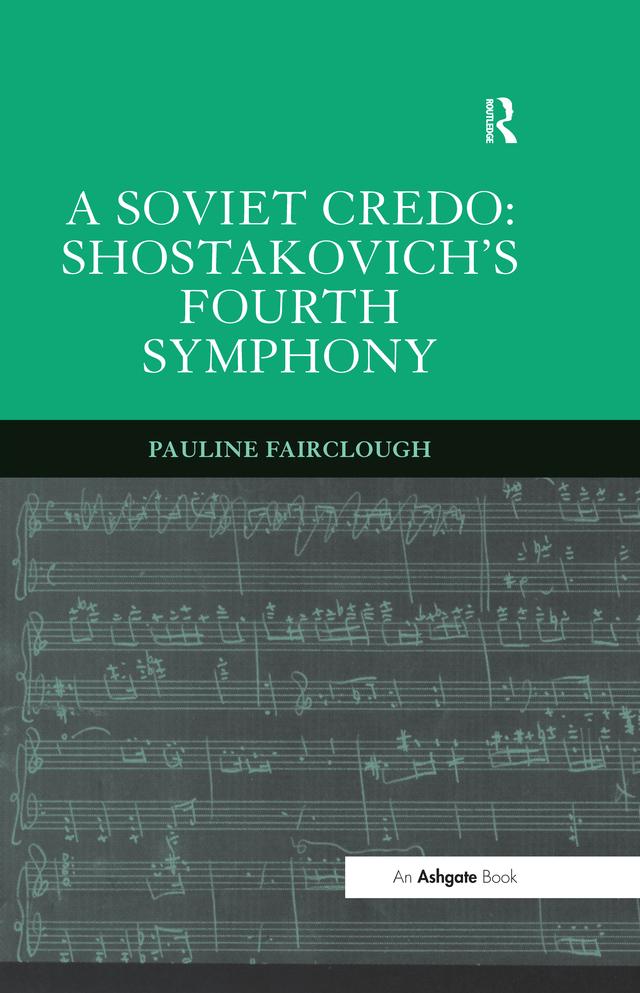
Composed in 1935-36 and intended to be his artistic 'credo', Shostakovich's Fourth Symphony was not performed publicly until 1961. Here, Dr Pauline Fairclough tackles head-on one of the most significant and least understood of Shostakovich's major works. She argues that the Fourth Symphony was radically different from its Soviet contemporaries in terms of its structure, dramaturgy, tone and even language, and therefore challenged the norms of Soviet symphonism at a crucial stage of its development. With the backing of prominent musicologists such as Ivan Sollertinsky, the composer could realistically have expected the premiere to have taken place, and may even have intended the symphony to be a model for a new kind of 'democratic' Soviet symphonism. Fairclough meticulously examines the score to inform a discussion of tonal and thematic processes, allusion, paraphrase and reference to musical types, or intonations. Such analysis is set deeply in the context of Soviet musical culture during the period 1932-36, involving Shostakovich's contemporaries Shebalin, Myaskovsky, Kabalevsky and Popov. A new method of analysis is also advanced here, where a range of Soviet and Western analytical methods are informed by the theoretical work of Shostakovich's contemporaries Viktor Shklovsky, Boris Tomashevsky, Mikhail Bakhtin and Ivan Sollertinsky, together with Theodor Adorno's late study of Mahler. In this way, the book will significantly increase an understanding of the symphony and its context.
Paga facilmente con carta, Klarna, Apple Pay o Google Pay. Non sei soddisfatto? Hai sempre 14 giorni per il rimborso. Leggi di più nei nostri termini. Per qualsiasi domanda, scrivici a hello@memmo.org.
Memmo rende lo studio più facile, ovunque tu sia nel mondo. Qui trovi i tuoi libri di testo e strumenti di studio intelligenti, tutto in un unico posto: riassunti, quiz, podcast e flashcard. E poi c'è Ted, il tuo compagno di studio che risponde a ogni tua domanda. Oltre 50.000 studenti studiano già qui: è stato creato per aiutarti a imparare più velocemente e a stressarti meno.
Potrebbe interessarti anche
Acquista il libro0