
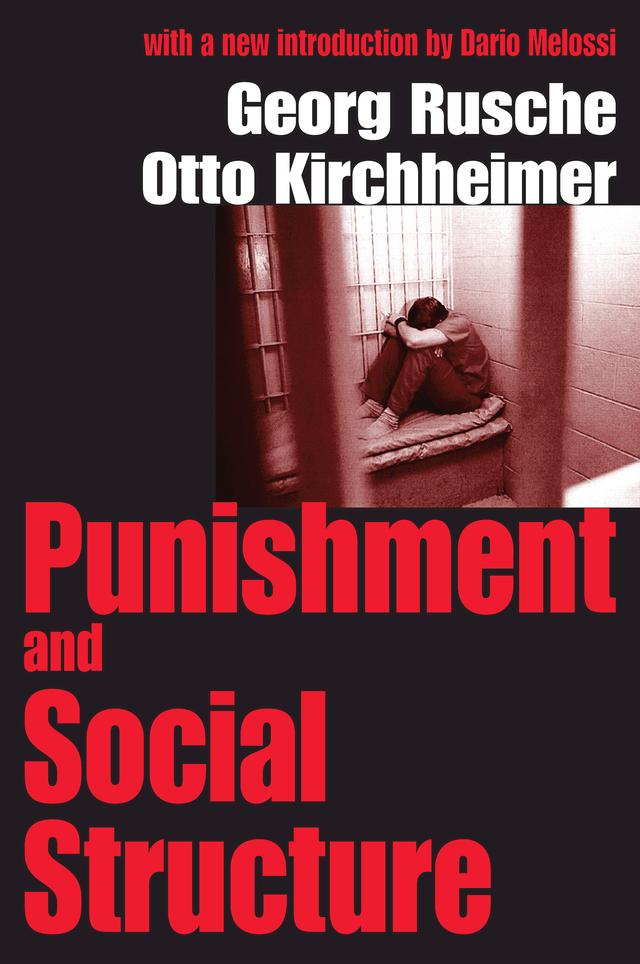
Why are certain methods of punishment adopted or rejected in a given social situation? To what extent is the development of penal methods determined by basic social relations? The answers to these questions are complex, and go well beyond the thesis that institutionalized punishment is simply for the protection of society. While today's punishment of offenders often incorporates aspects of psychology, psychiatry, and sociology, at one time there was a more pronounced difference in criminal punishment based on class and economics. Punishment and Social Structure originated from an article written by Georg Rusche in 1933 entitled "Labor Market and Penal Sanction: Thoughts on the Sociology of Criminal Justice." Originally published in Germany by the Frankfurt Institute of Social Research, this article became the germ of a theory of criminology that laid the groundwork for all subsequent research in this area. Rusche and Kirchheimer look at crime from an historical perspective, and correlate methods of punishment with both temporal cultural values and economic conditions. The authors classify the history of crime into three primary eras: the early Middle Ages, in which penance and fines were the predominant modes of punishment; the later Middle Ages, in which harsh corporal punishment and capital punishment moved to the forefront; and the seventeenth century, in which the prison system was more fully developed. They also discuss more recent forms of penal practice, most notably under the constraints of a fascist state.The majority of the book was translated from German into English, and then reshaped by Rusche's co-author, Otto Kirchheimer, with whom Rusche actually had little discussion. While the main body of Punishment and Social Structure are Rusche's ideas, Kirchheimer was responsible for bringing the book more up-to-date to include the Nazi and fascist era. Punishment and Social Structure is a pioneering work that sets a paradigm for the study of crime and punishment.
Paga facilmente con carta, Klarna, Apple Pay o Google Pay. Non sei soddisfatto? Hai sempre 14 giorni per il rimborso. Leggi di più nei nostri termini. Per qualsiasi domanda, scrivici a hello@memmo.org.
Memmo rende lo studio più facile, ovunque tu sia nel mondo. Qui trovi i tuoi libri di testo e strumenti di studio intelligenti, tutto in un unico posto: riassunti, quiz, podcast e flashcard. E poi c'è Ted, il tuo compagno di studio che risponde a ogni tua domanda. Oltre 50.000 studenti studiano già qui: è stato creato per aiutarti a imparare più velocemente e a stressarti meno.
Potrebbe interessarti anche
Acquista il libro0