
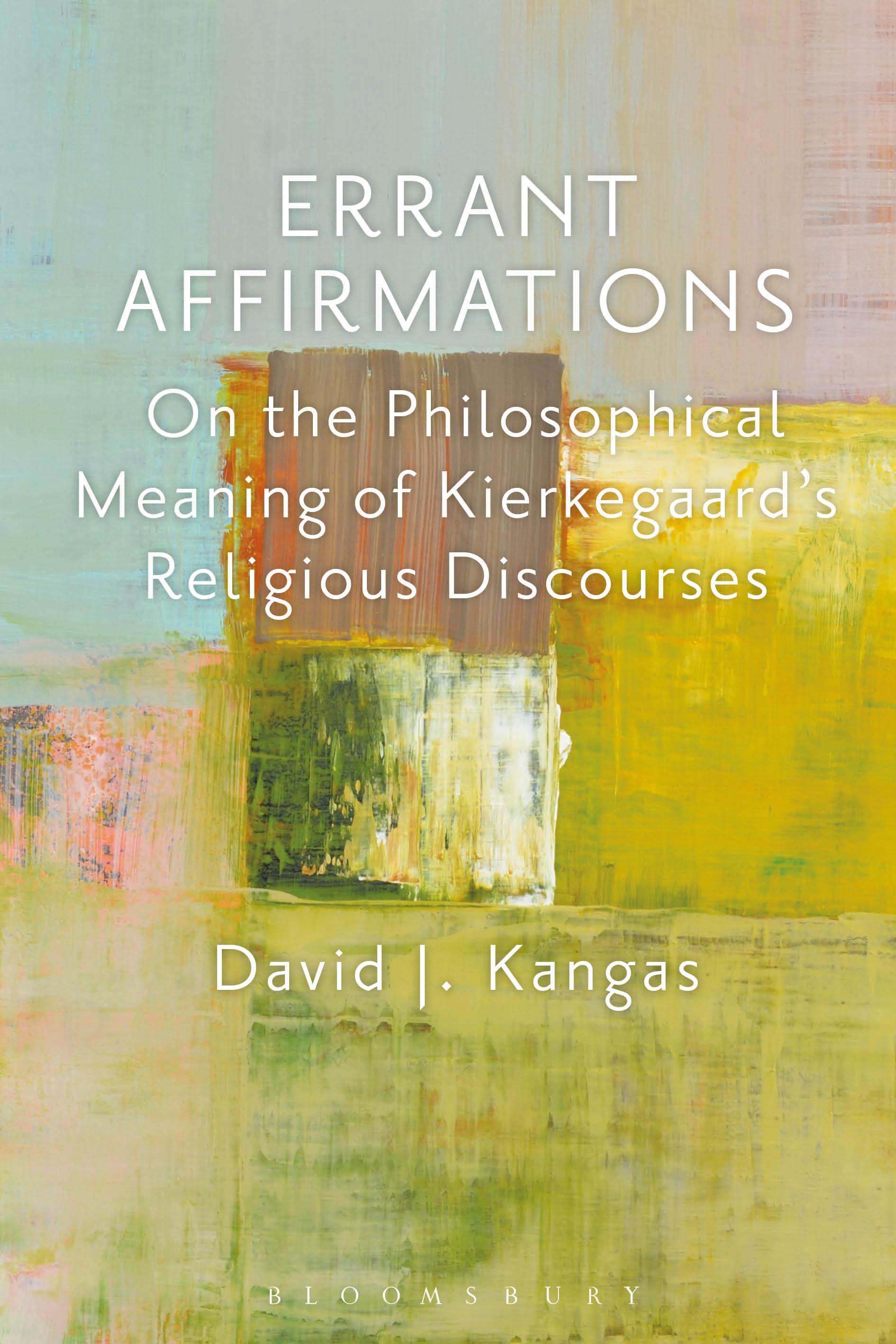
Kierkegaard's religious discourses - his writings which have explicitly dealt with religion - have historically been given scant attention by philosophers. They have generally been considered to be of less philosophical interest than his 'proper' philosophy. Errant Affirmations radically questions this claim and considers Kierkegaard's religious writings as absolutely central to his philosophical vision.
Through close and clear readings of Kierkegaard's work, David Kangas argues that contemporary philosophical themes - gift, temporality, language, death, nothingness, economy and selfhood- are not only evident in the 'religious' works but explored with real depth and fascination. Above all, the book argues that Kierkegaard's positive account of the human condition, his “ontology,” fully emerges only in these discourses. It shows how these discourses are organized around an “errant” kind of affirmation-namely, an affirmation of existence that is without conditions. Such affirmation involves the intensification of life around “today” and coincides with a joy that has no particular cause. It is an affirmation capable of affirming life even amidst its finitude and suffering.
Errant Affirmations is a fresh interpretation of Kierkegaard's understudied works that not only opens up a new reading of Kierkegaard but elucidates his 'religious' texts and places them organically within his philosophy as a whole.
Through close and clear readings of Kierkegaard's work, David Kangas argues that contemporary philosophical themes - gift, temporality, language, death, nothingness, economy and selfhood- are not only evident in the 'religious' works but explored with real depth and fascination. Above all, the book argues that Kierkegaard's positive account of the human condition, his “ontology,” fully emerges only in these discourses. It shows how these discourses are organized around an “errant” kind of affirmation-namely, an affirmation of existence that is without conditions. Such affirmation involves the intensification of life around “today” and coincides with a joy that has no particular cause. It is an affirmation capable of affirming life even amidst its finitude and suffering.
Errant Affirmations is a fresh interpretation of Kierkegaard's understudied works that not only opens up a new reading of Kierkegaard but elucidates his 'religious' texts and places them organically within his philosophy as a whole.
Paga facilmente con carta, Klarna, Apple Pay o Google Pay. Non sei soddisfatto? Hai sempre 14 giorni per il rimborso. Leggi di più nei nostri termini. Per qualsiasi domanda, scrivici a hello@memmo.org.
Memmo rende lo studio più facile, ovunque tu sia nel mondo. Qui trovi i tuoi libri di testo e strumenti di studio intelligenti, tutto in un unico posto: riassunti, quiz, podcast e flashcard. E poi c'è Ted, il tuo compagno di studio che risponde a ogni tua domanda. Oltre 50.000 studenti studiano già qui: è stato creato per aiutarti a imparare più velocemente e a stressarti meno.