
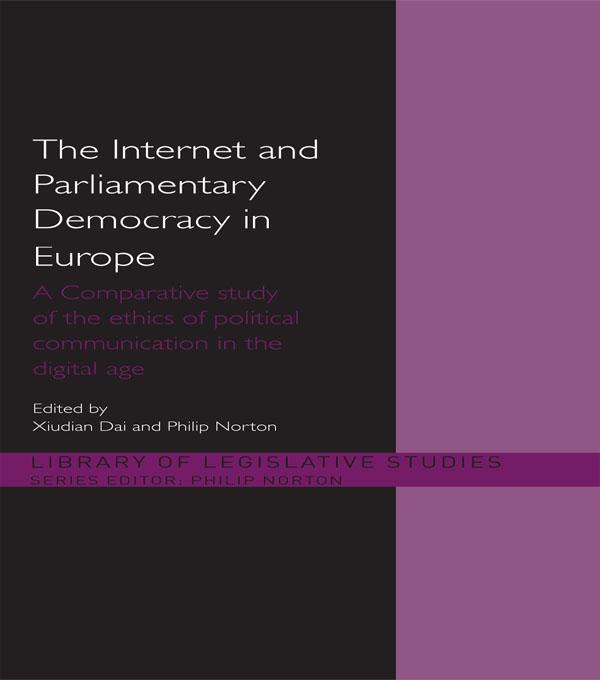
This book investigates the ethical challenges the internet presents to contemporary parliamentary democracy in Europe and how these challenges are being addressed. It fills an important gap: current literature until now has largely focused on the study of internet usage by politicians and institutions.
With the ever widening scope of participation in internet-based communication, there are widely differing views on its potential social, economic and political impact, and whether parliamentary democracy will be strengthened or weakened in the information age. Key questions include:
- To what extent is the internet being used in parliamentary political communication (the ethics of behaviour)?
- Should there be any institutional control and monitoring of parliamentarians’ use of the internet (the ethics of code of conduct)?
- What impact does the internet have upon the principle of trust and transparency in the context of parliamentary democracy (the ethics of accountability)?
The book compares four European parliaments: the British, European, Portuguese and Swedish Parliaments, using both quantitative methods (questionnaires and survey of websites) and qualitative methods (workshops and face-to-face interviews with parliamentarians and parliamentary staff).
This book was previously published as a special issue of the Journal of Legislative Studies.
Paga facilmente con carta, Klarna, Apple Pay o Google Pay. Non sei soddisfatto? Hai sempre 14 giorni per il rimborso. Leggi di più nei nostri termini. Per qualsiasi domanda, scrivici a hello@memmo.org.
Memmo rende lo studio più facile, ovunque tu sia nel mondo. Qui trovi i tuoi libri di testo e strumenti di studio intelligenti, tutto in un unico posto: riassunti, quiz, podcast e flashcard. E poi c'è Ted, il tuo compagno di studio che risponde a ogni tua domanda. Oltre 50.000 studenti studiano già qui: è stato creato per aiutarti a imparare più velocemente e a stressarti meno.