
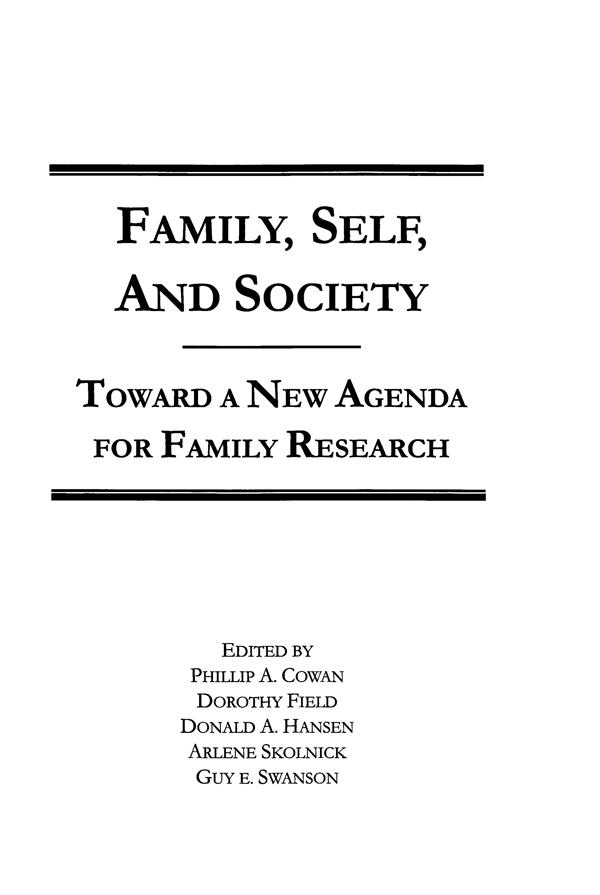
Any agenda for family research in the 1990s must take seriously a contextual approach to the study of family relationships. The editors and contributors to this volume believe that the richness in family studies over the next decade will come from considering the diversity of family forms -- different ethnic groups and cultures, different stages of family life, as well as different historical cohorts. Their goal is to make more explicit how we think about families in order to study them and understand them. To illustrate the need for diversity in family studies, examples are presented from new and old families, majority and minority families, American and Japanese families, and intact and divorcing families. This variety is intended to push the limits of current thinking, not only for researchers but also for all who are struggling to live with and work with families in a time when family life is valued but fragmented and relatively unsupported by society's institutions. Students and researchers interested in family development from the viewpoint of any of the social sciences will find this book of value.
Paga facilmente con carta, Klarna, Apple Pay o Google Pay. Non sei soddisfatto? Hai sempre 14 giorni per il rimborso. Leggi di più nei nostri termini. Per qualsiasi domanda, scrivici a hello@memmo.org.
Memmo rende lo studio più facile, ovunque tu sia nel mondo. Qui trovi i tuoi libri di testo e strumenti di studio intelligenti, tutto in un unico posto: riassunti, quiz, podcast e flashcard. E poi c'è Ted, il tuo compagno di studio che risponde a ogni tua domanda. Oltre 50.000 studenti studiano già qui: è stato creato per aiutarti a imparare più velocemente e a stressarti meno.