
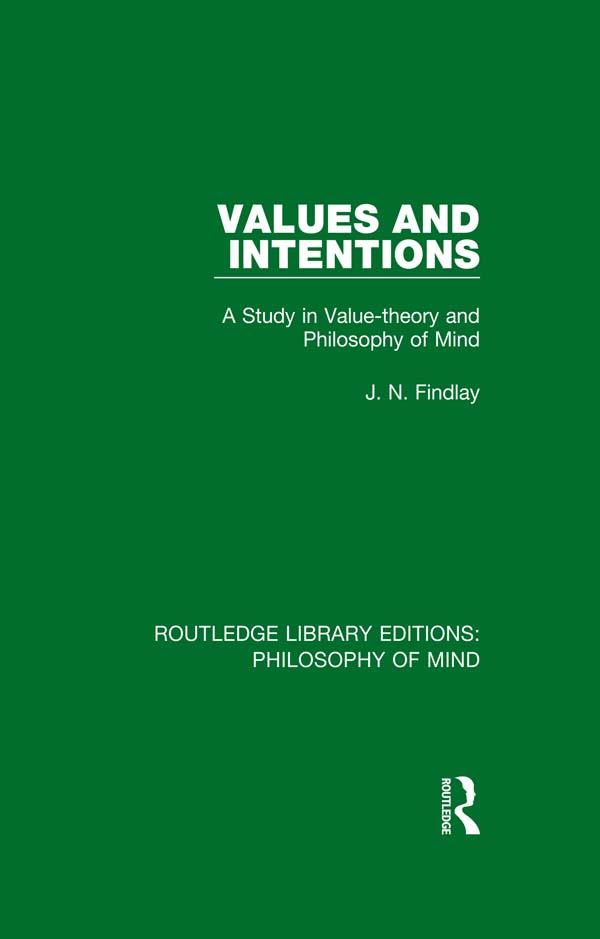
Professor Findlay in this book, originally published in 1961, set out to justify, and to some extent carry out, a ‘material value-ethic’, ie. A systematic setting forth of the ends of rational action.
The book is in the tradition of Moore, Rashfall, Ross, Scheler and Hartmann though it avoids altogether dogmatic intuitive methods. It argues that an organised framework of ends of action follows from the attitude underlying our moral pronouncements, and that this framework, while allowing personal elaboration, is not a matter for individual decision. The relations connecting our fundamental value-judgements with one another, and the frames of mind behind them, are not rigorously deductive but are sufficiently compelling to be called logical. Something of a ‘transcendental deduction’ of a well-ordered family for our basic heads of valuation is both possible and necessary. The work is further critical of the notion of obligation which has been extended far beyond legal contracts and understandings. The book also contains a chapter on religion.
Paga facilmente con carta, Klarna, Apple Pay o Google Pay. Non sei soddisfatto? Hai sempre 14 giorni per il rimborso. Leggi di più nei nostri termini. Per qualsiasi domanda, scrivici a hello@memmo.org.
Memmo rende lo studio più facile, ovunque tu sia nel mondo. Qui trovi i tuoi libri di testo e strumenti di studio intelligenti, tutto in un unico posto: riassunti, quiz, podcast e flashcard. E poi c'è Ted, il tuo compagno di studio che risponde a ogni tua domanda. Oltre 50.000 studenti studiano già qui: è stato creato per aiutarti a imparare più velocemente e a stressarti meno.