
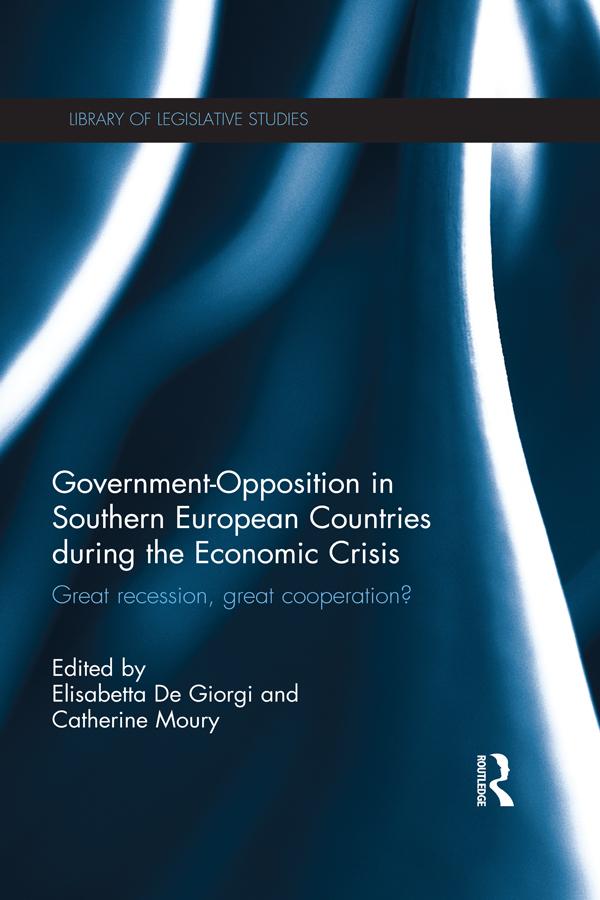
As a result of the financial crisis, opposition parties have had to choose between the need to cooperate with the majority in order to contribute to necessary socio-economic changes, and the opportunity to stress their adversarial position vis-à-vis governments taking radical and unpopular measures.
This book examines how opposition parties address this dilemma. It relies on a qualitative and quantitative analysis of the behaviour of the opposition parties in parliament, in light of the socio-economic issues that have arisen in recent years. It focuses in particular on the impact that the economic malaise has had on the government-opposition dynamics in the four southern European democracies most acutely hit by the crisis: Greece, Italy, Portugal and Spain, as well as in the European Parliament. Each chapter utilizes a combination of empirical data analysis and qualitative process-tracking to understand the opposition parties’ complicated choice between supporting and dissenting.
This book was originally published as a special issue of the Journal of Legislative Studies.
Paga facilmente con carta, Klarna, Apple Pay o Google Pay. Non sei soddisfatto? Hai sempre 14 giorni per il rimborso. Leggi di più nei nostri termini. Per qualsiasi domanda, scrivici a hello@memmo.org.
Memmo rende lo studio più facile, ovunque tu sia nel mondo. Qui trovi i tuoi libri di testo e strumenti di studio intelligenti, tutto in un unico posto: riassunti, quiz, podcast e flashcard. E poi c'è Ted, il tuo compagno di studio che risponde a ogni tua domanda. Oltre 50.000 studenti studiano già qui: è stato creato per aiutarti a imparare più velocemente e a stressarti meno.