
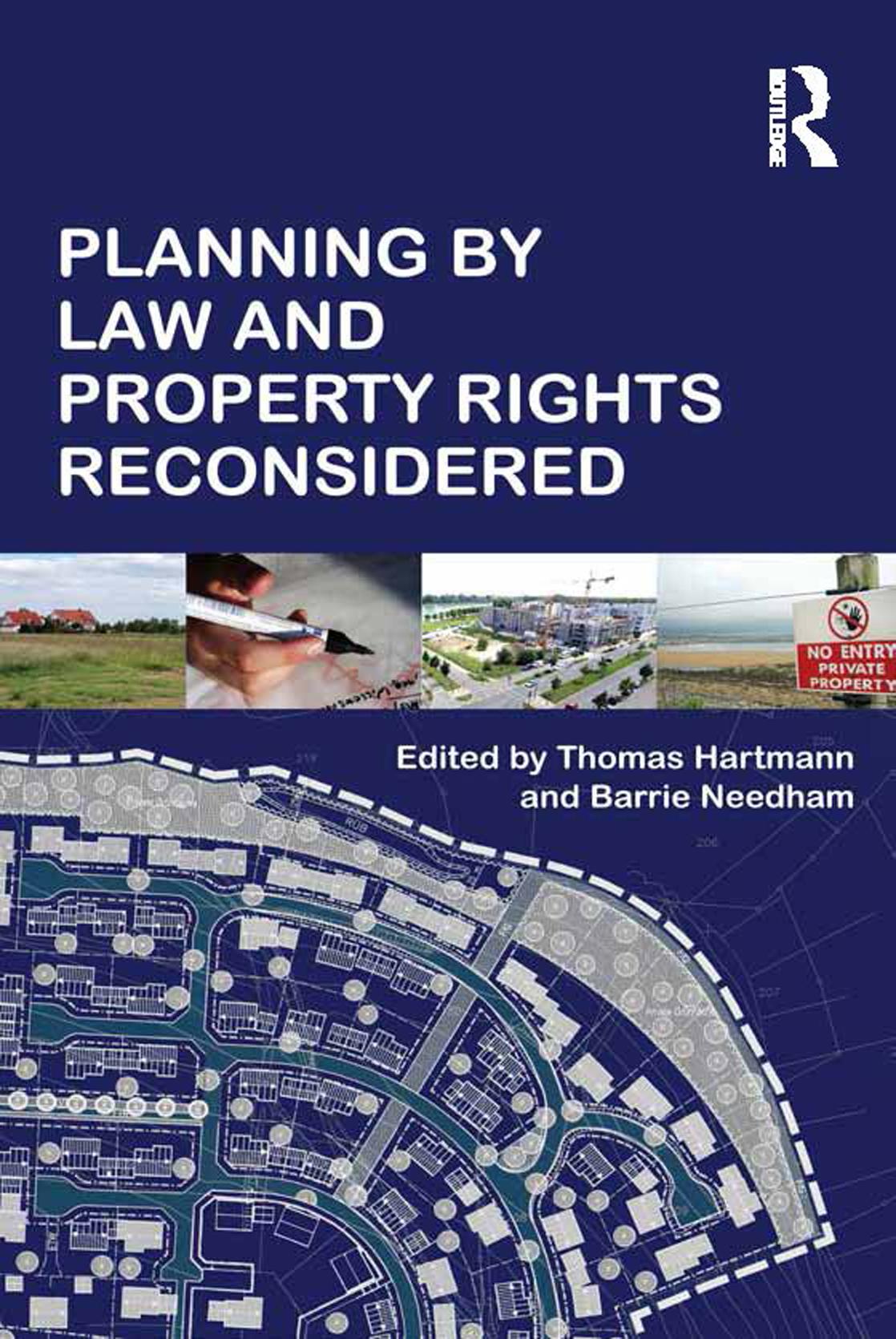
Countries which take spatial planning seriously should take planning law and property rights also seriously. There is an unavoidable logical relationship between planning, law, and property rights. However, planning by law and property rights is so familiar and taken for granted that we do not think about the theory behind it. As a result, we do not think abstractly about its strengths and weaknesses, about what can be achieved with it and what not, how it can be improved, how it could be complemented. Such reflections are essential to cope with current and future challenges to spatial planning. This book makes the (often implicit) theory behind planning by law and property rights explicit and relates it to those challenges. It starts by setting out what is understood by planning by law and property rights, and investigates - theoretically and by game simulation - the relationships between planning law and property rights. It then places planning law and property rights within their institutional setting at three different scales: when a country undergoes enormous social and political change, when there is fundamental political debate about the power of the state within a country, and when a country changes its legislation in response to European policy. Not only changing institutions, but also global environmental change, pose huge challenges for spatial planning. The book discusses how planning by law and property rights can respond to those challenges: by adaptive planning), by adaptable property rights, and by public policies at the appropriate geographical level. Planning by law and property rights can fix a local regime of property rights which turns out to be inappropriate but difficult to change. It questions whether such regimes can be changed and whether planning agencies can make such undesirable lock-ins less likely by reducing market uncertainty and, if so, by what means.
Pagine: 248
Categoria: Arkitektur & Stadsplanering
e-ISBN: 9781317080190
Peso di spedizione: 1.2 kg
Spedito in: 1-2 giorni
Paga facilmente con carta, Klarna, Apple Pay o Google Pay. Non sei soddisfatto? Hai sempre 14 giorni per il rimborso. Leggi di più nei nostri termini. Per qualsiasi domanda, scrivici a hello@memmo.org.
Memmo rende lo studio più facile, ovunque tu sia nel mondo. Qui trovi i tuoi libri di testo e strumenti di studio intelligenti, tutto in un unico posto: riassunti, quiz, podcast e flashcard. E poi c'è Ted, il tuo compagno di studio che risponde a ogni tua domanda. Oltre 50.000 studenti studiano già qui: è stato creato per aiutarti a imparare più velocemente e a stressarti meno.
Potrebbe interessarti anche
Acquista il libro0