
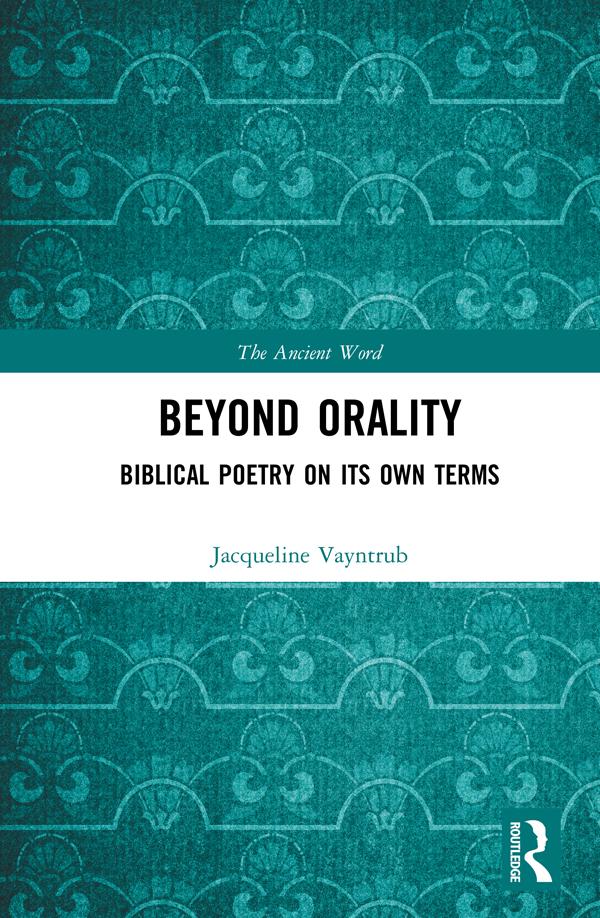
Central to understanding the prophecy and prayer of the Hebrew Bible are the unspoken assumptions that shaped them—their genres. Modern scholars describe these works as “poetry,” but there was no corresponding ancient Hebrew term or concept. Scholars also typically assume it began as “oral literature,” a concept based more in evolutionist assumptions than evidence. Is biblical poetry a purely modern fiction, or is there a more fundamental reason why its definition escapes us?
Beyond Orality: Biblical Poetry on its Own Terms changes the debate by showing how biblical poetry has worked as a mirror, reflecting each era’s own self-image of verbal art. Yet Vayntrub also shows that this problem is rooted in a crucial pattern within the Bible itself: the texts we recognize as “poetry” are framed as powerful and ancient verbal performances, dramatic speeches from the past. The Bible’s creators presented what we call poetry in terms of their own image of the ancient and the oral, and understanding their native theories of Hebrew verbal art gives us a new basis to rethink our own.
Paga facilmente con carta, Klarna, Apple Pay o Google Pay. Non sei soddisfatto? Hai sempre 14 giorni per il rimborso. Leggi di più nei nostri termini. Per qualsiasi domanda, scrivici a hello@memmo.org.
Memmo rende lo studio più facile, ovunque tu sia nel mondo. Qui trovi i tuoi libri di testo e strumenti di studio intelligenti, tutto in un unico posto: riassunti, quiz, podcast e flashcard. E poi c'è Ted, il tuo compagno di studio che risponde a ogni tua domanda. Oltre 50.000 studenti studiano già qui: è stato creato per aiutarti a imparare più velocemente e a stressarti meno.