
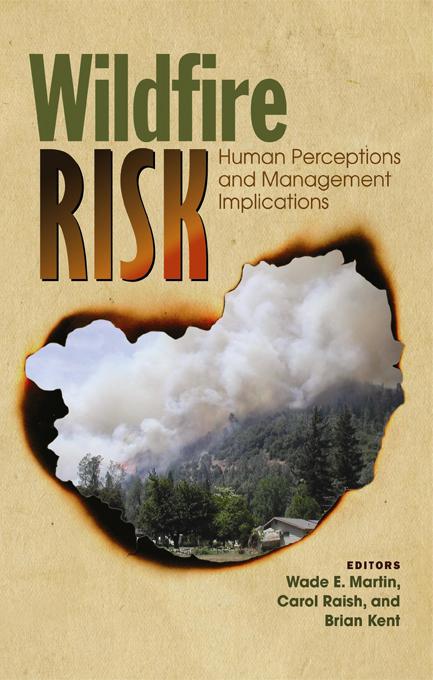
The continuing encroachment of human settlements into fire-prone areas and extreme fire seasons in recent years make it urgent that we better understand both the physical and human dimensions of managing the risk from wildfire. Wildfire Risk follows from our awareness that increasing public knowledge about wildfire hazard does not necessarily lead to appropriate risk reduction behavior. Drawing heavily upon health and risk communication, and risk modeling, the authors advance our understanding of how individuals and communities respond to wildfire hazard. They present results of original research on the social, economic, and psychological factors in responses to risk, discuss how outreach and education can influence behavior, and consider differences among ethnic/racial groups and between genders with regard to values, views, and attitudes about wildfire risk. They explore the role of public participation in risk assessment and mitigation, as well as in planning for evacuation and recovery after fire. Wildfire Risk concludes with a dedicated section on risk-modeling, with perspectives from decision sciences, geography, operations research, psychology, experimental economics, and other social sciences.
Paga facilmente con carta, Klarna, Apple Pay o Google Pay. Non sei soddisfatto? Hai sempre 14 giorni per il rimborso. Leggi di più nei nostri termini. Per qualsiasi domanda, scrivici a hello@memmo.org.
Memmo rende lo studio più facile, ovunque tu sia nel mondo. Qui trovi i tuoi libri di testo e strumenti di studio intelligenti, tutto in un unico posto: riassunti, quiz, podcast e flashcard. E poi c'è Ted, il tuo compagno di studio che risponde a ogni tua domanda. Oltre 50.000 studenti studiano già qui: è stato creato per aiutarti a imparare più velocemente e a stressarti meno.
Potrebbe interessarti anche
Acquista il libro0