
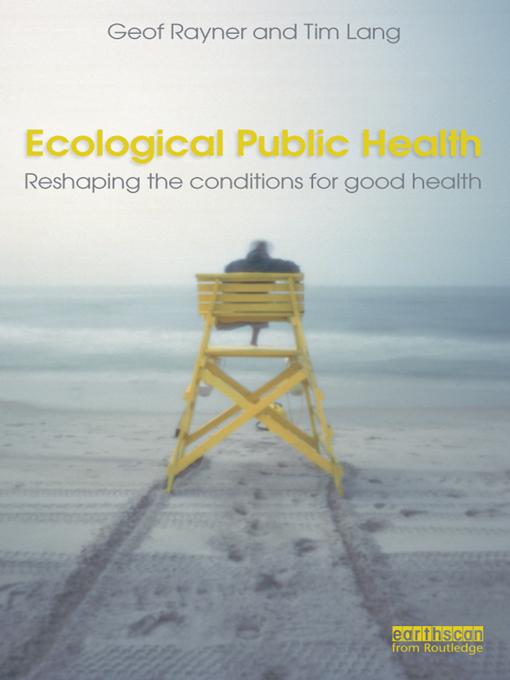
What is public health? To some, it is about drains, water, food and housing, all requiring engineering and expert management. To others, it is the State using medicine or health education and tackling unhealthy lifestyles.
This book argues that public health thinking needs an overhaul, a return to and modernisation around ecological principles. Ecological Public Health thinking, outlined here, fits the twenty-first century’s challenges. It integrates what the authors call the four dimensions of existence: the material, biological, social and cultural aspects of life. Public health becomes the task of transforming the relationship between people, their circumstances and the biological world of nature and bodies. For Geof Rayner and Tim Lang, this is about facing a number of long-term transitions, some well recognized, others not. These transitions are Demographic, Epidemiological, Urban, Energy, Economic, Nutrition, Biological, Cultural and Democracy itself.
The authors argue that identifying large scale transitions such as these refocuses public health actions onto the conditions on which human and eco-systems health interact. Making their case, Rayner and Lang map past confusions in public health images, definitions and models. This is an optimistic book, arguing public health can be rescued from its current dilemmas and frustrations. This century’s agenda is unavoidably complex, however, and requires stronger and more daring combinations of interdisciplinary work, movements and professions locally, nationally and globally. Outlining these in the concluding section, the book charts a positive and reinvigorated institutional purpose.
Paga facilmente con carta, Klarna, Apple Pay o Google Pay. Non sei soddisfatto? Hai sempre 14 giorni per il rimborso. Leggi di più nei nostri termini. Per qualsiasi domanda, scrivici a hello@memmo.org.
Memmo rende lo studio più facile, ovunque tu sia nel mondo. Qui trovi i tuoi libri di testo e strumenti di studio intelligenti, tutto in un unico posto: riassunti, quiz, podcast e flashcard. E poi c'è Ted, il tuo compagno di studio che risponde a ogni tua domanda. Oltre 50.000 studenti studiano già qui: è stato creato per aiutarti a imparare più velocemente e a stressarti meno.