
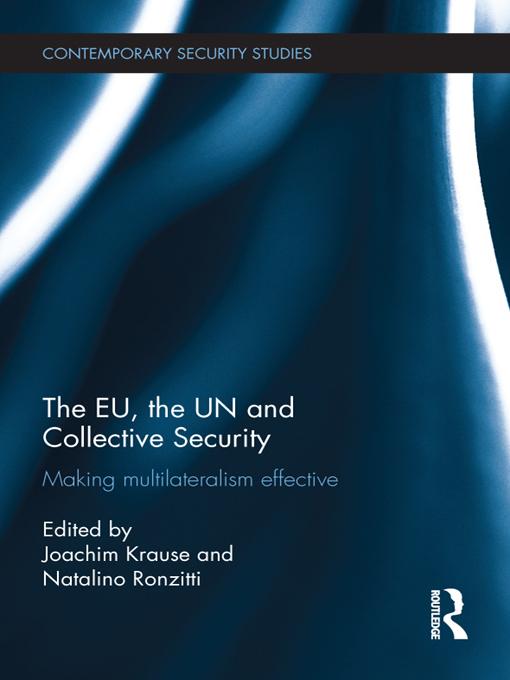
This book examines the effectiveness of multilateralism in ensuring collective security and, in particular, the EU’s role in this process.
In 1992, shortly after the end of the Cold War, a Security Council Summit in New York reaffirmed the salience of the system of collective security and stated the determination of the Heads of State to maintain it as the prime international instrument for preserving peace. Twenty years later, however, the record of collective security as well as of multilateralism has not been very encouraging. The system of collective security, as enshrined in the United Nations (UN) Charter, failed repeatedly to accomplish its mandate in the 1990s and has led to controversial debates in the United States and Europe that reached a climax during the Iraq crisis in 2002/03.
The volume draws upon both theoretical and empirical research to answer the following core questions:
- What are the reasons that have made multilateralism either effective or ineffective in the field of peacekeeping, peace preservation and peacebuilding?
- How can multilateralism be made more effective?
- How can attempts made by Europe to render UN multilateralism in the security area more efficient be assessed?
This book will be of much interest to students of peacebuilding/peacekeeping, EU policy, the UN, security studies and IR in general.
Paga facilmente con carta, Klarna, Apple Pay o Google Pay. Non sei soddisfatto? Hai sempre 14 giorni per il rimborso. Leggi di più nei nostri termini. Per qualsiasi domanda, scrivici a hello@memmo.org.
Memmo rende lo studio più facile, ovunque tu sia nel mondo. Qui trovi i tuoi libri di testo e strumenti di studio intelligenti, tutto in un unico posto: riassunti, quiz, podcast e flashcard. E poi c'è Ted, il tuo compagno di studio che risponde a ogni tua domanda. Oltre 50.000 studenti studiano già qui: è stato creato per aiutarti a imparare più velocemente e a stressarti meno.