
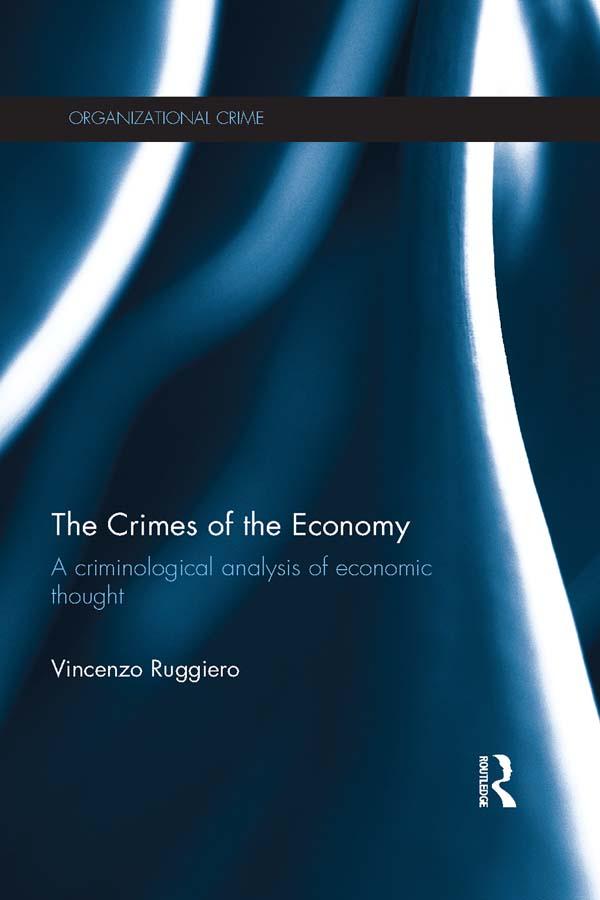
Economists have often paid visits to the field of criminology, examining the rational logic of offending. When economists examine criminal activity, they imply that offenders should be treated like any other social actor making rational choices.
In The Crimes of the Economy, Vincenzo Ruggiero turns the tables by examining a variety of economic schools of thought from a criminological perspective. Each one of these schools, he argues, justifies or even encourages harm produced by economic initiative. He investigates – among others – John Locke’s notion of private property, Mercantilism, the Physiocrats and Malthus, and the arguments of Adam Smith, Marshall, Keynes and neoliberalism. In each of these, the author identifies the potential justification of different forms of ‘crimes of the economy’ and victimisation.
This book re-examines the history of economic thought, assessing it as the history of a discipline which, while attempting to gain scientific status, in reality seeks to make the social harm caused by economics acceptable. The book will be interesting and relevant to students and scholars of social theory, criminology, economics, philosophy and politics.
Paga facilmente con carta, Klarna, Apple Pay o Google Pay. Non sei soddisfatto? Hai sempre 14 giorni per il rimborso. Leggi di più nei nostri termini. Per qualsiasi domanda, scrivici a hello@memmo.org.
Memmo rende lo studio più facile, ovunque tu sia nel mondo. Qui trovi i tuoi libri di testo e strumenti di studio intelligenti, tutto in un unico posto: riassunti, quiz, podcast e flashcard. E poi c'è Ted, il tuo compagno di studio che risponde a ogni tua domanda. Oltre 50.000 studenti studiano già qui: è stato creato per aiutarti a imparare più velocemente e a stressarti meno.