
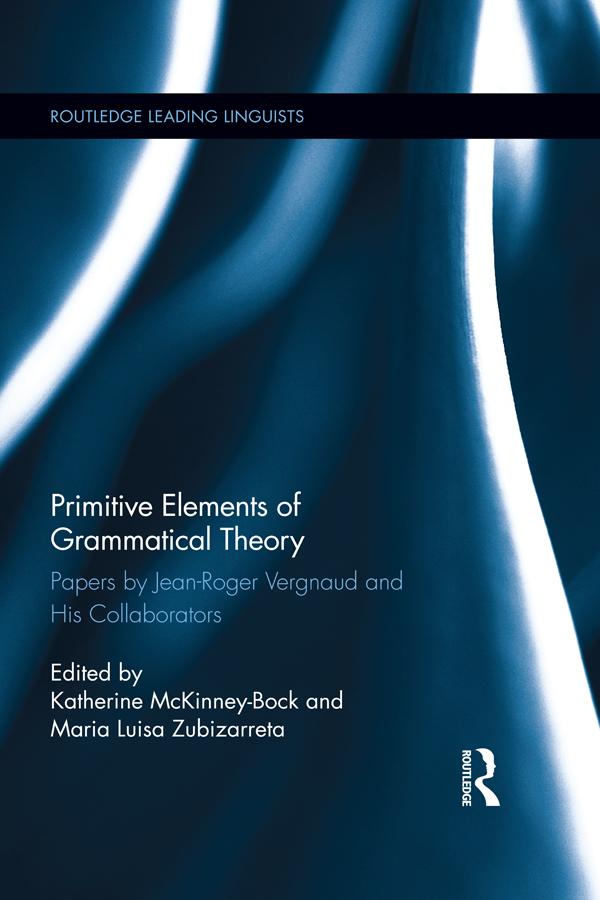
This book is a compilation of manuscripts and publications from 2001-2010 by Jean-Roger Vergnaud, in collaboration with colleagues and students. This work is guided by the scientific belief that broader mathematical principles should guide linguistic inquiry, as they guide classical biology and physics. From this, Vergnaud’s hypotheses take the representation of the computational component of language to a more abstract level: one that derives constituent structure. He treats linguistic features as primitives, and argues that a 2 x n matrix allows for multiple discrete dimensions to represent symmetries in linguistic features and to derive the fabric of syntax (and perhaps of phonology as well).
Three primary research questions guide the core of these papers. (A) Methodologically, how can broadly defined mathematical/cognitive principles guide linguistic investigation? (B) To what extent do general mathematical principles apply across linguistic domains? What principles guide computation at different levels of linguistic structure (phonology, metrical structure, syntax)? (C) How is the computational domain defined?
In these manuscripts, Vergnaud’s goal is not to radically depart from the Minimalist Program within generative grammar, but rather to take the underlying goal of the generative program and bring it to an even more general scientific level. The themes of symmetry and periodicity in this book reflect his goal of scientific progress in linguistics, and he has opened the doors to new exploration of old empirical problems in linguistics that may, someday, have deeper biological and physical explanations through the theory presented in this publication.
Paga facilmente con carta, Klarna, Apple Pay o Google Pay. Non sei soddisfatto? Hai sempre 14 giorni per il rimborso. Leggi di più nei nostri termini. Per qualsiasi domanda, scrivici a hello@memmo.org.
Memmo rende lo studio più facile, ovunque tu sia nel mondo. Qui trovi i tuoi libri di testo e strumenti di studio intelligenti, tutto in un unico posto: riassunti, quiz, podcast e flashcard. E poi c'è Ted, il tuo compagno di studio che risponde a ogni tua domanda. Oltre 50.000 studenti studiano già qui: è stato creato per aiutarti a imparare più velocemente e a stressarti meno.