
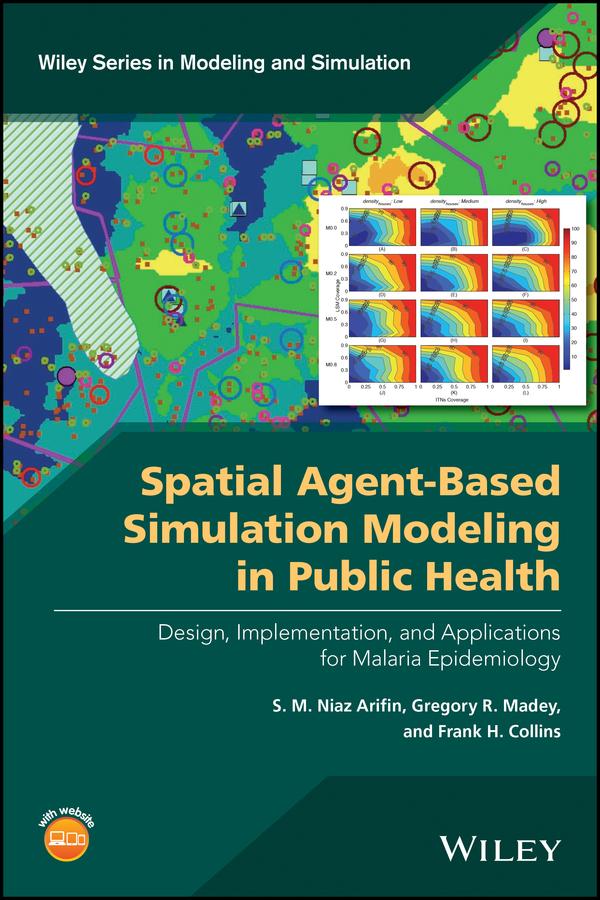
Presents an overview of the complex biological systems used within a global public health setting and features a focus on malaria analysis
Bridging the gap between agent-based modeling and simulation (ABMS) and geographic information systems (GIS), Spatial Agent-Based Simulation Modeling in Public Health: Design, Implementation, and Applications for Malaria Epidemiology provides a useful introduction to the development of agent-based models (ABMs) by following a conceptual and biological core model of Anopheles gambiae for malaria epidemiology. Using spatial ABMs, the book includes mosquito (vector) control interventions and GIS as two example applications of ABMs, as well as a brief description of epidemiology modeling. In addition, the authors discuss how to most effectively integrate spatial ABMs with a GIS. The book concludes with a combination of knowledge from entomological, epidemiological, simulation-based, and geo-spatial domains in order to identify and analyze relationships between various transmission variables of the disease.
Spatial Agent-Based Simulation Modeling in Public Health: Design, Implementation, and Applications for Malaria Epidemiology also features:
- Location-specific mosquito abundance maps that play an important role in malaria control activities by guiding future resource allocation for malaria control and identifying hotspots for further investigation
- Discussions on the best modeling practices in an effort to achieve improved efficacy, cost-effectiveness, ecological soundness, and sustainability of vector control for malaria
- An overview of the various ABMs, GIS, and spatial statistical methods used in entomological and epidemiological studies, as well as the model malaria study
- A companion website with computer source code and flowcharts of the spatial ABM and a landscape generator tool that can simulate landscapes with varying spatial heterogeneity of different types of resources including aquatic habitats and houses
Spatial Agent-Based Simulation Modeling in Public Health: Design, Implementation, and Applications for Malaria Epidemiology is an excellent reference for professionals such as modeling and simulation experts, GIS experts, spatial analysts, mathematicians, statisticians, epidemiologists, health policy makers, as well as researchers and scientists who use, manage, or analyze infectious disease data and/or infectious disease-related projects. The book is also ideal for graduate-level courses in modeling and simulation, bioinformatics, biostatistics, public health and policy, and epidemiology.
Paga facilmente con carta, Klarna, Apple Pay o Google Pay. Non sei soddisfatto? Hai sempre 14 giorni per il rimborso. Leggi di più nei nostri termini. Per qualsiasi domanda, scrivici a hello@memmo.org.
Memmo rende lo studio più facile, ovunque tu sia nel mondo. Qui trovi i tuoi libri di testo e strumenti di studio intelligenti, tutto in un unico posto: riassunti, quiz, podcast e flashcard. E poi c'è Ted, il tuo compagno di studio che risponde a ogni tua domanda. Oltre 50.000 studenti studiano già qui: è stato creato per aiutarti a imparare più velocemente e a stressarti meno.