
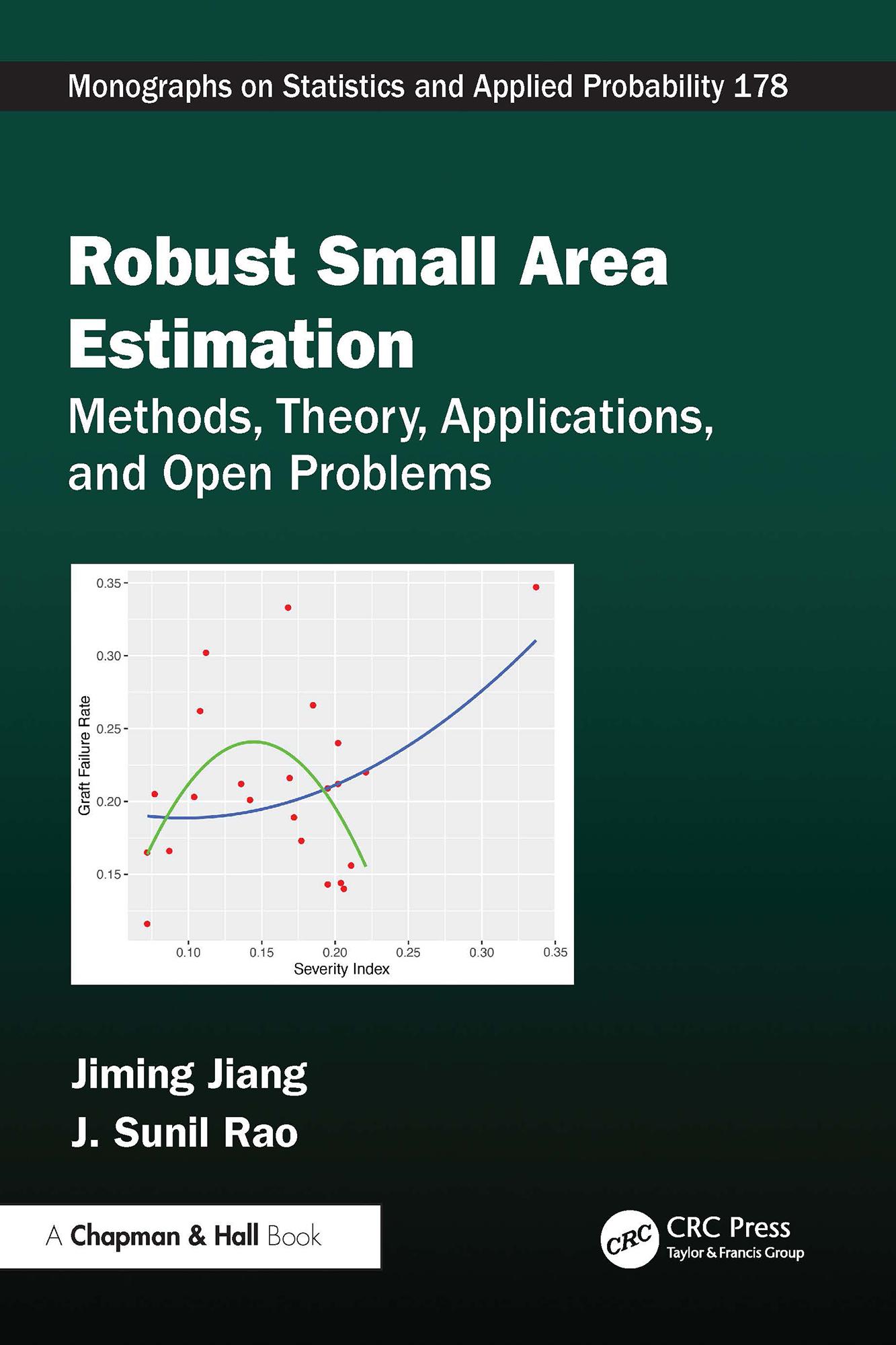
In recent years there has been substantial and growing interest in small area estimation (SAE) that is largely driven by practical demands. Here, the term "small area" typically refers to a subpopulation or domain of interest for which a reliable direct estimate, based only on the domain-specific sample, cannot be produced due to small sample size in the domain.
Keywords in SAE are “borrowing strength”. Because there are insufficient samples from the small areas to produce reliable direct estimates, statistical methods are sought to utilize other sources of information to do better than the direct estimates. A typical way of borrowing strength is via statistical modelling. On the other hand, there is no “free lunch”. Yes, one can do better by borrowing strength, but there is a cost. This is the main topic discussed in this text.
Features
- A comprehensive account of methods, applications, as well as some open problems related to robust SAE
- Methods illustrated by worked examples and case studies using real data
- Discusses some advanced topics including benchmarking, Bayesian approaches, machine learning methods, missing data, and classified mixed model prediction
- Supplemented with code and data via a website
Robust Small Area Estimation: Methods, Applications, and Open Problems is primarily aimed at researchers and graduate students of statistics and data science and would also be suitable for geography and survey methodology researchers. The practical approach should help persuade practitioners, such as those in government agencies, to more readily adopt robust SAE methods. It could be used to teach a graduate-level course to students with a background in mathematical statistics.
Paga facilmente con carta, Klarna, Apple Pay o Google Pay. Non sei soddisfatto? Hai sempre 14 giorni per il rimborso. Leggi di più nei nostri termini. Per qualsiasi domanda, scrivici a hello@memmo.org.
Memmo rende lo studio più facile, ovunque tu sia nel mondo. Qui trovi i tuoi libri di testo e strumenti di studio intelligenti, tutto in un unico posto: riassunti, quiz, podcast e flashcard. E poi c'è Ted, il tuo compagno di studio che risponde a ogni tua domanda. Oltre 50.000 studenti studiano già qui: è stato creato per aiutarti a imparare più velocemente e a stressarti meno.