
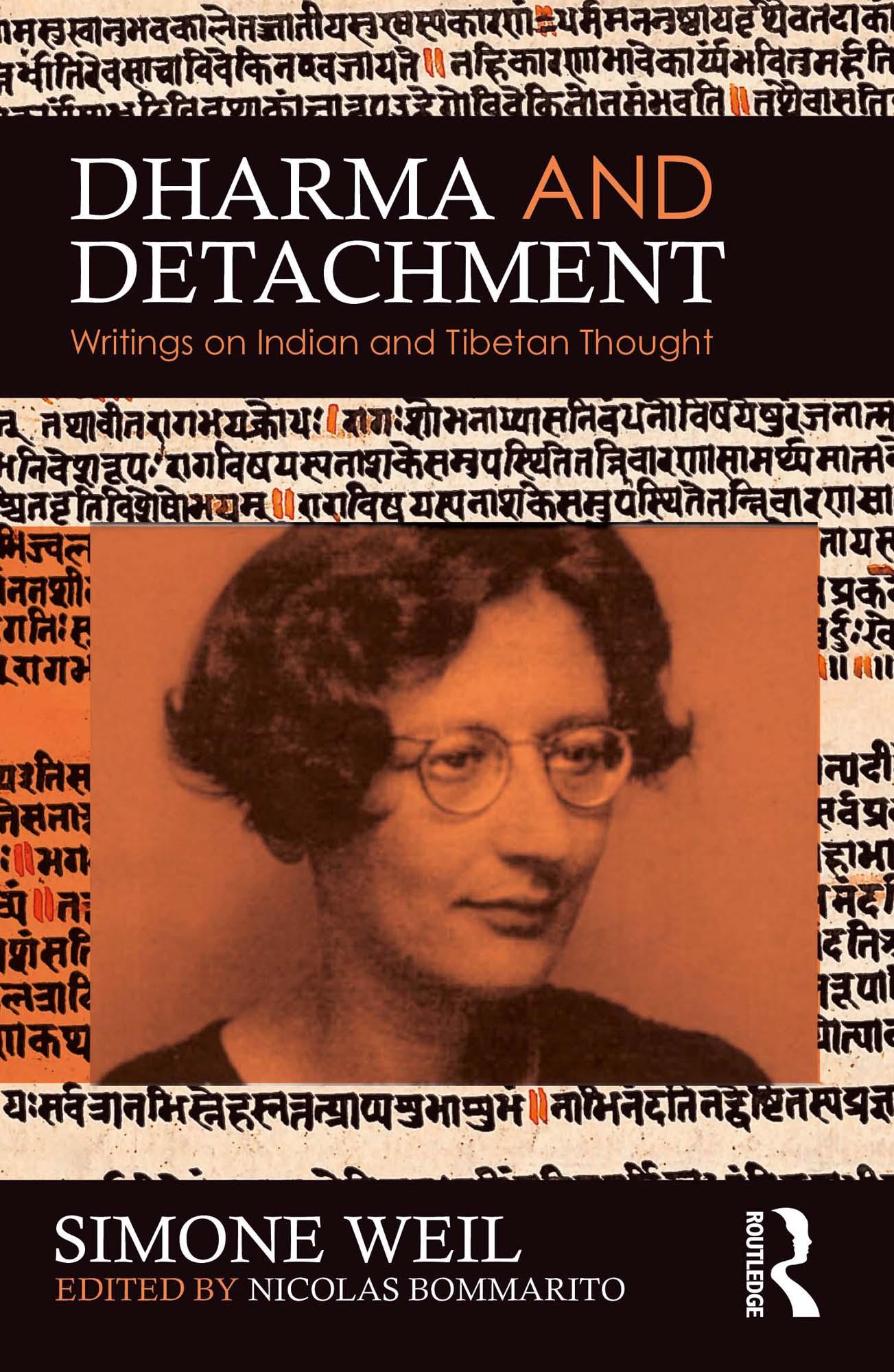
Simone Weil was one of the most profound and thought-provoking thinkers of the twentieth century. An intellectual prodigy from an early age in both the sciences and the arts, she was at different times a teacher, factory and farm labourer, and political activist, spending a brief period in Spain during the Spanish Civil War. Her writings, which span philosophy, politics, religion and spirituality, are marked by a both passionate and contemplative attempt to understand profound questions about the good, God, human thought and action, and suffering and beauty.
However, considerably less known is Weil's fascination with the texts and ideas of Indian and Tibetan thought, which she both thought and wrote about extensively. Dharma and Detachment: Writings on Indian and Tibetan Thought is the first volume to draw together some of Weil's most interesting and important writings on eastern thought.
Expertly edited and introduced by Nicolas Bommarito, the anthology contains writings drawn from Weil's extensive Notebooks. The extracts show how she moves seamlessly between Plato, Catholicism, mathematics, the Bhagavad-Gītā, and Buddhism, engaging with texts in the original Sanskrit. To help the reader gain a full insight into Weil's thought, the volume also includes – along with Weil's own writings – key passages from the classical texts that inspired her, especially the Bhagavad-Gītā and the Upanis.ads.
In addition to a helpful Introduction by Nicolas Bommarito setting out the background to Weil's life and her engagement with Indo-Tibetan texts, he also explains fundamental Indo-Tibetan philosophical terms such as ātman, the three gunòas, karma and detachment. A glossary is also included, making the volume an ideal starting point for those unfamiliar with Indo-Tibetan philosophy and seeking a clear path into Weil's engagement with these texts and ideas.
Dharma and Detachment: Writings on Indian and Tibetan Thought will be of great interest to all readers and students of Simone Weil's work, as well as to those interested in Indian and Tibetan philosophy, religion, and phenomenology.
Paga facilmente con carta, Klarna, Apple Pay o Google Pay. Non sei soddisfatto? Hai sempre 14 giorni per il rimborso. Leggi di più nei nostri termini. Per qualsiasi domanda, scrivici a hello@memmo.org.
Memmo rende lo studio più facile, ovunque tu sia nel mondo. Qui trovi i tuoi libri di testo e strumenti di studio intelligenti, tutto in un unico posto: riassunti, quiz, podcast e flashcard. E poi c'è Ted, il tuo compagno di studio che risponde a ogni tua domanda. Oltre 50.000 studenti studiano già qui: è stato creato per aiutarti a imparare più velocemente e a stressarti meno.