
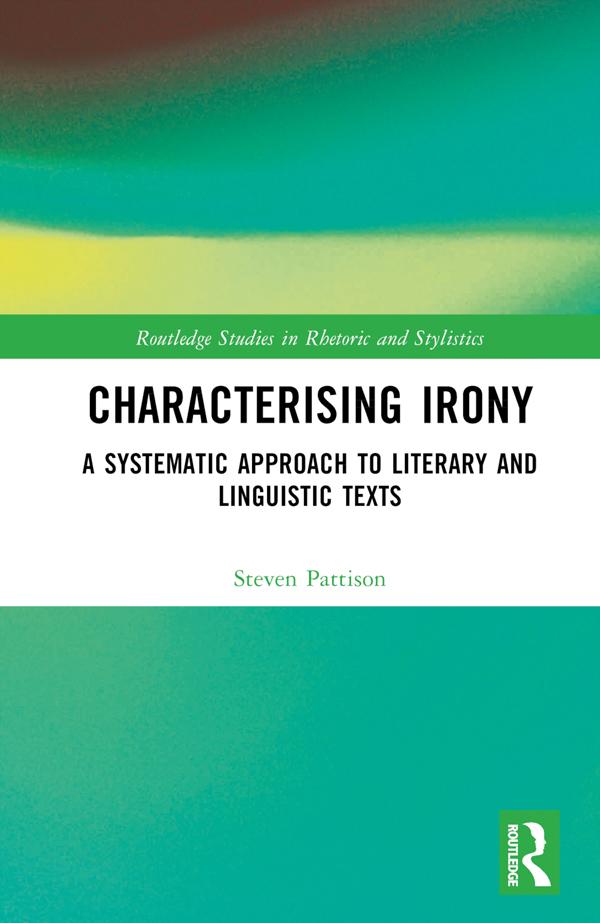
This book offers a systematic, bottom-up account of irony across both everyday contexts and literary and linguistic texts, using an empirically rigorous approach in distinguishing between central irony, non-central ironies, and non-ironies and highlighting a new way forward for irony research.
The volume considers the current landscape of irony, in which the term is used with increasing frequency with the knock-on effect of a loosening of its meaning. Pattison addresses this challenge by applying a systematic form of analysis, rooted in frameworks from pragmatics and complementary disciplines, to a database of over 500 irony candidates from a wide range of sources. The book uses these examples to illustrate the features of central ironies as well as the attributes used to differentiate between central ironies, non-central ironies, and non-ironies. These attributes are mapped across four key domains, including: difference and opposition; the role of context; how ironies are signaled; and speaker attitude and intention. Taken together, the volume puts forth a credible account for more clearly characterizing examples of irony and equips researchers with a comprehensive step-by-step method for undertaking future research.
This book is key reading for scholars in stylistics, pragmatics, literary studies, and psycholinguistics.
Paga facilmente con carta, Klarna, Apple Pay o Google Pay. Non sei soddisfatto? Hai sempre 14 giorni per il rimborso. Leggi di più nei nostri termini. Per qualsiasi domanda, scrivici a hello@memmo.org.
Memmo rende lo studio più facile, ovunque tu sia nel mondo. Qui trovi i tuoi libri di testo e strumenti di studio intelligenti, tutto in un unico posto: riassunti, quiz, podcast e flashcard. E poi c'è Ted, il tuo compagno di studio che risponde a ogni tua domanda. Oltre 50.000 studenti studiano già qui: è stato creato per aiutarti a imparare più velocemente e a stressarti meno.