
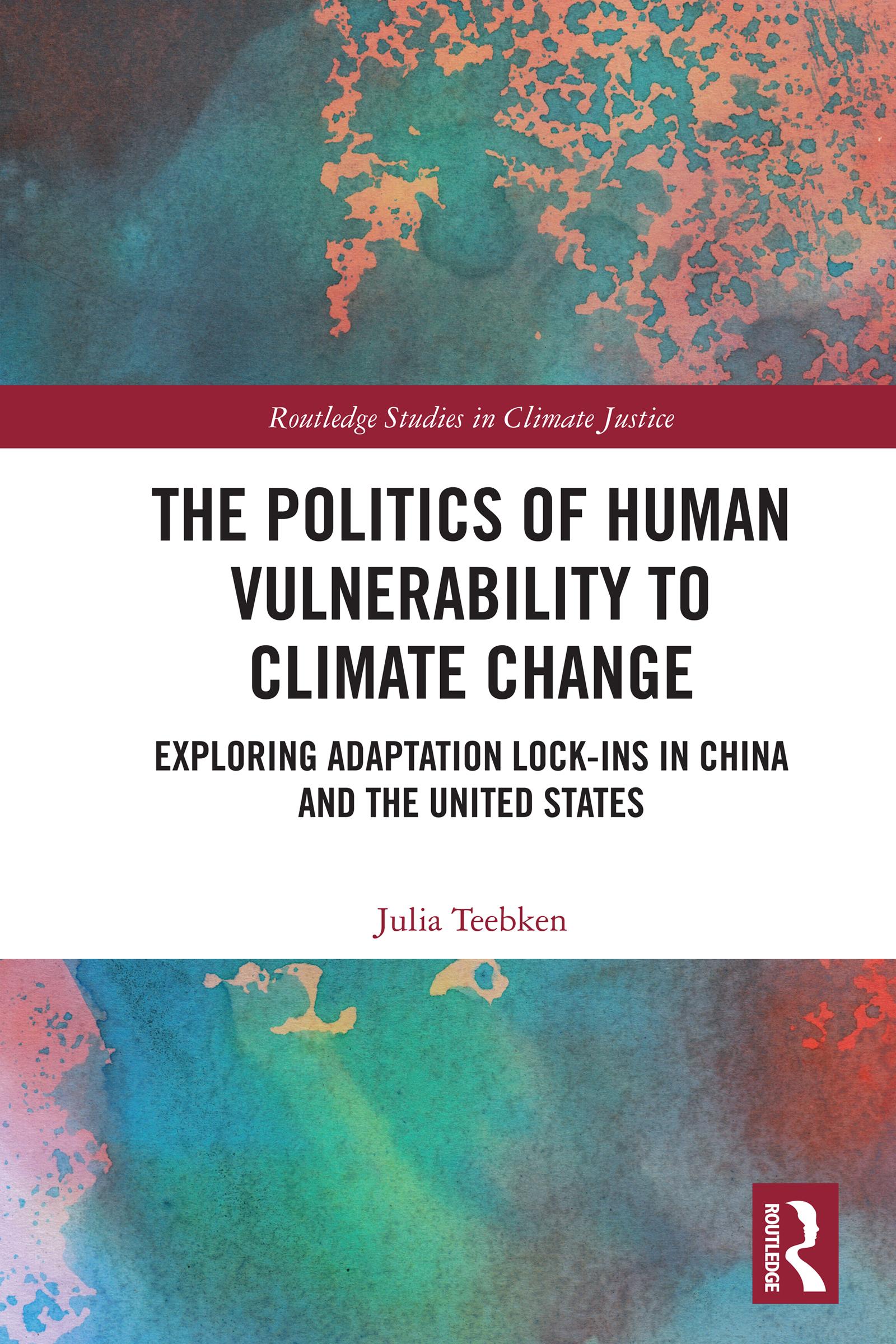
This book compares how the social consequences of climate change are similarly unevenly distributed within China and the United States, despite different political systems.
Focusing on the cases of Atlanta, USA, and Jinhua, China, Julia Teebken explores a set of path-dependent factors (lock-ins), which hamper the pursuit of climate adaptation by local governments to adequately address the root causes of vulnerability. Lock-ins help to explain why adaptation efforts in both locations are incremental and commonly focus on greening the environment. In both these political systems, vulnerability appears as a core component along with the reconstitution of a class-based society. This manifests in the way knowledge and political institutions operate. For this reason, Teebken challenges the argument that China’s environmental authoritarian structures are better equipped in dealing with matters related to climate change. She also interrogates the proposition that certain aspects of the liberal democratic tradition of the United States are better suited in dealing with social justice issues in the context of adaptation. Overall, the book’s findings contradict the widespread assumption that developed countries necessarily have higher adaptive capacity than developing or emerging economies.
This volume will be of great interest to students and scholars of climate justice and vulnerability, climate adaptation and environmental policy and governance.
Paga facilmente con carta, Klarna, Apple Pay o Google Pay. Non sei soddisfatto? Hai sempre 14 giorni per il rimborso. Leggi di più nei nostri termini. Per qualsiasi domanda, scrivici a hello@memmo.org.
Memmo rende lo studio più facile, ovunque tu sia nel mondo. Qui trovi i tuoi libri di testo e strumenti di studio intelligenti, tutto in un unico posto: riassunti, quiz, podcast e flashcard. E poi c'è Ted, il tuo compagno di studio che risponde a ogni tua domanda. Oltre 50.000 studenti studiano già qui: è stato creato per aiutarti a imparare più velocemente e a stressarti meno.