
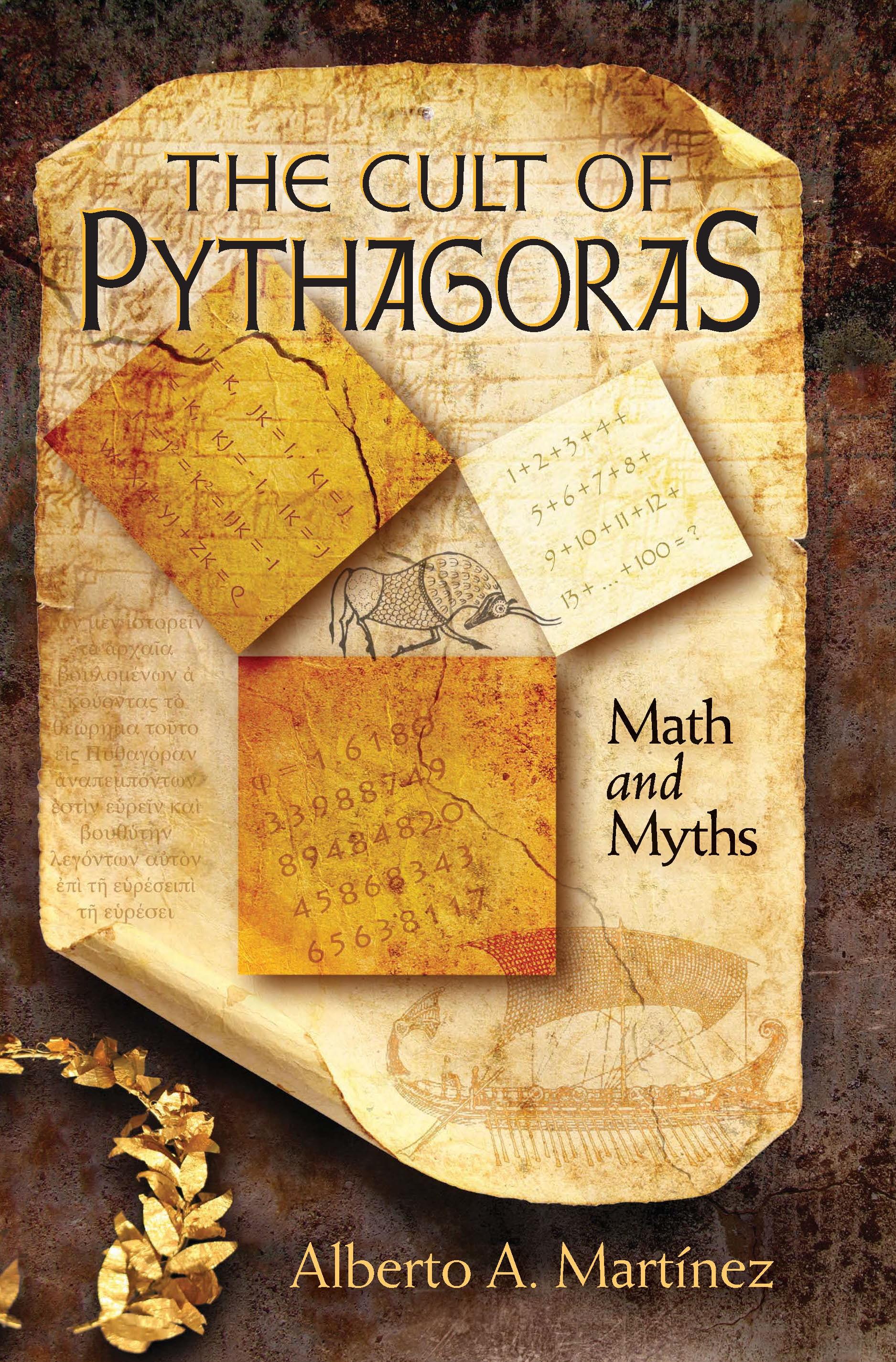
In this follow-up to his popular Science Secrets, Alberto A. Martinez discusses various popular myths from the history of mathematics: that Pythagoras proved the hypotenuse theorem, that Archimedes figured out how to test the purity of a gold crown while he was in a bathtub, that the Golden Ratio is in nature and ancient architecture, that the young Galois created group theory the night before the pistol duel that killed him, and more. Some stories are partly true, others are entirely false, but all show the power of invention in history. Pythagoras emerges as a symbol of the urge to conjecture and "fill in the gaps" of history. He has been credited with fundamental discoveries in mathematics and the sciences, yet there is nearly no evidence that he really contributed anything to such fields at all. This book asks: how does history change when we subtract the many small exaggerations and interpolations that writers have added for over two thousand years?
The Cult of Pythagoras is also about invention in a positive sense. Most people view mathematical breakthroughs as "discoveries" rather than invention or creativity, believing that mathematics describes a realm of eternal ideas. But mathematicians have disagreed about what is possible and impossible, about what counts as a proof, and even about the results of certain operations. Was there ever invention in the history of concepts such as zero, negative numbers, imaginary numbers, quaternions, infinity, and infinitesimals?
Martinez inspects a wealth of primary sources, in several languages, over a span of many centuries. By exploring disagreements and ambiguities in the history of the elements of mathematics, The Cult of Pythagoras dispels myths that obscure the actual origins of mathematical concepts. Martinez argues that an accurate history that analyzes myths reveals neglected aspects of mathematics that can encourage creativity in students and mathematicians.
The Cult of Pythagoras is also about invention in a positive sense. Most people view mathematical breakthroughs as "discoveries" rather than invention or creativity, believing that mathematics describes a realm of eternal ideas. But mathematicians have disagreed about what is possible and impossible, about what counts as a proof, and even about the results of certain operations. Was there ever invention in the history of concepts such as zero, negative numbers, imaginary numbers, quaternions, infinity, and infinitesimals?
Martinez inspects a wealth of primary sources, in several languages, over a span of many centuries. By exploring disagreements and ambiguities in the history of the elements of mathematics, The Cult of Pythagoras dispels myths that obscure the actual origins of mathematical concepts. Martinez argues that an accurate history that analyzes myths reveals neglected aspects of mathematics that can encourage creativity in students and mathematicians.
Categoria: Vetenskapsteori och forskningsmetod
e-ISBN: 9780822978534
Peso di spedizione: 1.2 kg
Spedito in: 1-2 giorni
Paga facilmente con carta, Klarna, Apple Pay o Google Pay. Non sei soddisfatto? Hai sempre 14 giorni per il rimborso. Leggi di più nei nostri termini. Per qualsiasi domanda, scrivici a hello@memmo.org.
Memmo rende lo studio più facile, ovunque tu sia nel mondo. Qui trovi i tuoi libri di testo e strumenti di studio intelligenti, tutto in un unico posto: riassunti, quiz, podcast e flashcard. E poi c'è Ted, il tuo compagno di studio che risponde a ogni tua domanda. Oltre 50.000 studenti studiano già qui: è stato creato per aiutarti a imparare più velocemente e a stressarti meno.
Potrebbe interessarti anche
Acquista il libro0