
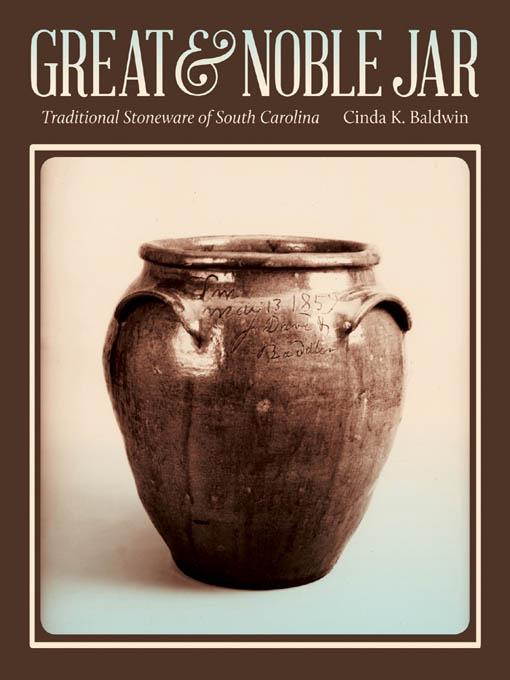
In Great and Noble Jar, Cinda K. Baldwin offers the first authoritative study of South Carolina stoneware and traces the ways in which a rich regional tradition emerged from a unique cultural source.
As Baldwin notes, South Carolina's old legislative district of Edgefield (an area now comprising Edgefield, Aiken, and Greenwood counties) has long been recognized as the place of origin for an alkaline-glazing process that came to characterize pottery produced throughout the lower South. The process developed during the early nineteenth century after the poisonous properties of lead-glazed stoneware became known. Abner Landrum, a newspaper editor and scientific farmer, was probably the first to combine locally available materials with Chinese glaze formulas to produce this new and safer alkaline-glazed stoneware.
The plantation operations of the Edgefield District, Baldwin shows, created a demand for large-scale food storage and preservation, often in containers of huge capacity. In response to this need, an extensive system of family-owned stoneware factories emerged. Reflecting the contributions of the many slaves and freed blacks who worked in the industry, the objects produced in these factories often incorporated African designs and techniques. Particularly notable were the "grotesques," or "voodoo jugs"—wheel-thrown vessels onto which the slave potters applied facial features in molded clay. Baldwin pays special attention to the remarkable work of a slave potter named Dave, who marked his wares with brief verse inscriptions, including this one found on a large food-storage container: "Great & Noble Jar, /hold sheep, goat, and bear."
Tracing the tradition's history through the post-Civil War period and the first half of the twentieth century, Baldwin also examines South Carolina pottery outside the Edgefield District and analyzes a variety of decorative treatments and forms. She concludes with a consideration of the decline and renewal of the southern folk pottery tradition.
The book is illustrated with nearly two hundred photographs (including fifteen color plates), maps, and drawings. Complementing earlier studies that focused on Georgia and North Carolina pottery, Great and Noble Jar is a significant contribution to the understanding of this heritage.
Paga facilmente con carta, Klarna, Apple Pay o Google Pay. Non sei soddisfatto? Hai sempre 14 giorni per il rimborso. Leggi di più nei nostri termini. Per qualsiasi domanda, scrivici a hello@memmo.org.
Memmo rende lo studio più facile, ovunque tu sia nel mondo. Qui trovi i tuoi libri di testo e strumenti di studio intelligenti, tutto in un unico posto: riassunti, quiz, podcast e flashcard. E poi c'è Ted, il tuo compagno di studio che risponde a ogni tua domanda. Oltre 50.000 studenti studiano già qui: è stato creato per aiutarti a imparare più velocemente e a stressarti meno.