
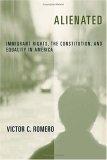
Throughout American history, the government has used U.S. citizenship and immigration law to protect privileged groups from less privileged ones, using citizenship as a “legitimate” proxy for otherwise invidious, and often unconstitutional, discrimination on the basis of race. While racial discrimination is rarely legally acceptable today, profiling on the basis of citizenship is still largely unchecked, and has in fact arguably increased in the wake of the September 11 terror attacks on the United States. In this thoughtful examination of the intersection between American immigration and constitutional law, Victor C. Romero draws our attention to a “constitutional immigration law paradox” that reserves certain rights for U.S. citizens only, while simultaneously purporting to treat all people fairly under constitutional law regardless of citizenship.
As a naturalized Filipino American, Romero brings an outsider's perspective to Alienated, forcing us to look at constitutional immigration law from the vantage point of people whose citizenship status is murky (either legally or from the viewpoint of other citizens and lawmakers), including foreign-born adoptees, undocumented immigrants, tourists, foreign students, and same-gender bi-national partners. Romero endorses an equality-based reading of the Constitution and advocates a new theoretical and practical approach that protects the individual rights of non-citizens without sacrificing their personhood.
Paga facilmente con carta, Klarna, Apple Pay o Google Pay. Non sei soddisfatto? Hai sempre 14 giorni per il rimborso. Leggi di più nei nostri termini. Per qualsiasi domanda, scrivici a hello@memmo.org.
Memmo rende lo studio più facile, ovunque tu sia nel mondo. Qui trovi i tuoi libri di testo e strumenti di studio intelligenti, tutto in un unico posto: riassunti, quiz, podcast e flashcard. E poi c'è Ted, il tuo compagno di studio che risponde a ogni tua domanda. Oltre 50.000 studenti studiano già qui: è stato creato per aiutarti a imparare più velocemente e a stressarti meno.