
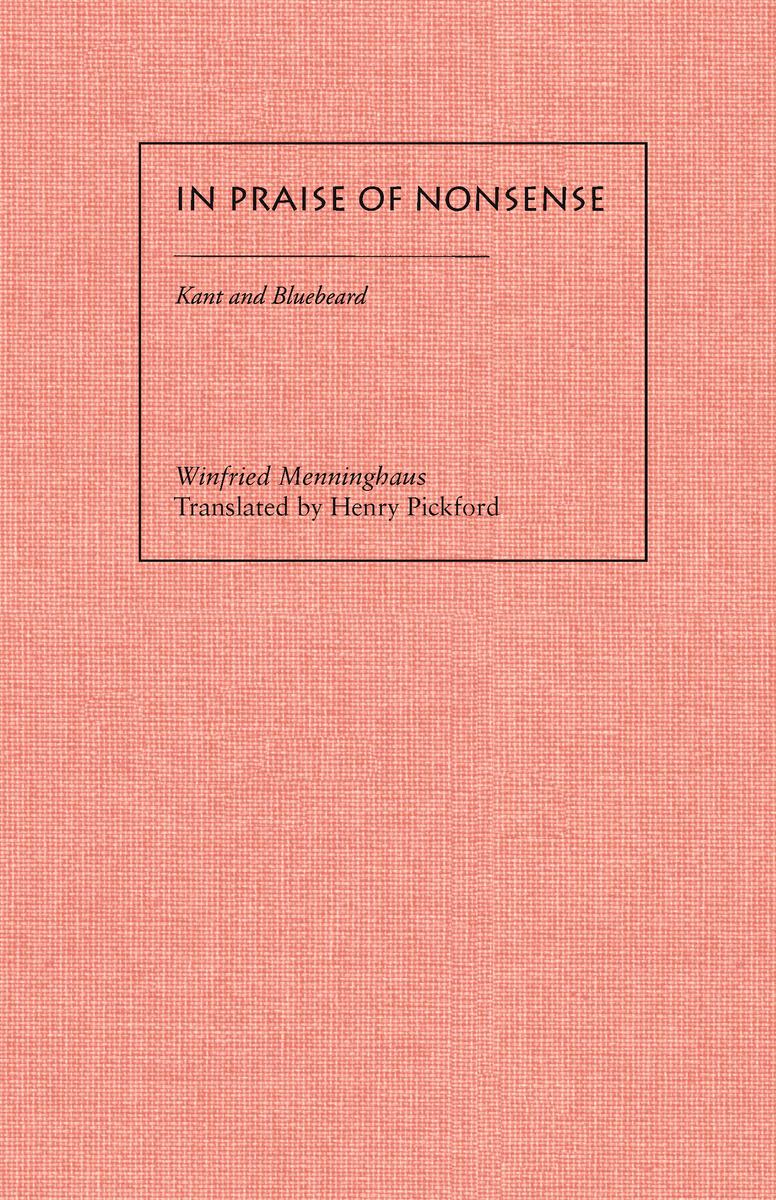
Shells, leafwork, picture frames, hummingbirds, wallpaper decorations, hems of clothing—such are the examples Kant's Critique of Judgment offers for a "free" and purely aesthetic beauty. Menninghaus's book demonstrates that all these examples refer to a widely unknown debate on the arabesque and that Kant, in displacing it, addresses genuinely "modern" phenomena. The early Romantic poetics and literature of the arabesque follow and radicalize Kant's move.
Menninghaus shows parergonality and "nonsense" to be two key features in the spread of the arabesque from architecture and the fine arts to philosophy and finally to literature. On the one hand, comparative readings of the parergon in Enlightenment aesthetics, Kant, and Schlegel reveal the importance of this term for establishing the very notion of a self-reflective work of art. On the other hand, drawing on Kant's posthumous anthropological notebooks, Menninghaus extrapolates an entire Kantian theory of what it means to produce nonsense and why the Critique of Judgment defines genius precisely through the power (as well as the dangers) of doing so.
Ludwig Tieck's 1797 rewriting of Charles Perrault's famous Bluebeard tale (1697) explicitly claims to be an "arabesque" book "without any sense and coherence." Menninghaus's close reading of this capricious narrative reveals a specifically Romantic—as opposed, say, to a Victorian or dadaistic—type of nonsense. Benjamin's as well as Propp's, Lévi-Strauss's, and Meletinskij's oppositions of myth and fairy tale lend additional credit to a Romantic poetics that inaugurates "universal poetry" while performing a bizarre trajectory through arabesque ornament, nonsense, parergonality, and the fairy tale.
Paga facilmente con carta, Klarna, Apple Pay o Google Pay. Non sei soddisfatto? Hai sempre 14 giorni per il rimborso. Leggi di più nei nostri termini. Per qualsiasi domanda, scrivici a hello@memmo.org.
Memmo rende lo studio più facile, ovunque tu sia nel mondo. Qui trovi i tuoi libri di testo e strumenti di studio intelligenti, tutto in un unico posto: riassunti, quiz, podcast e flashcard. E poi c'è Ted, il tuo compagno di studio che risponde a ogni tua domanda. Oltre 50.000 studenti studiano già qui: è stato creato per aiutarti a imparare più velocemente e a stressarti meno.