
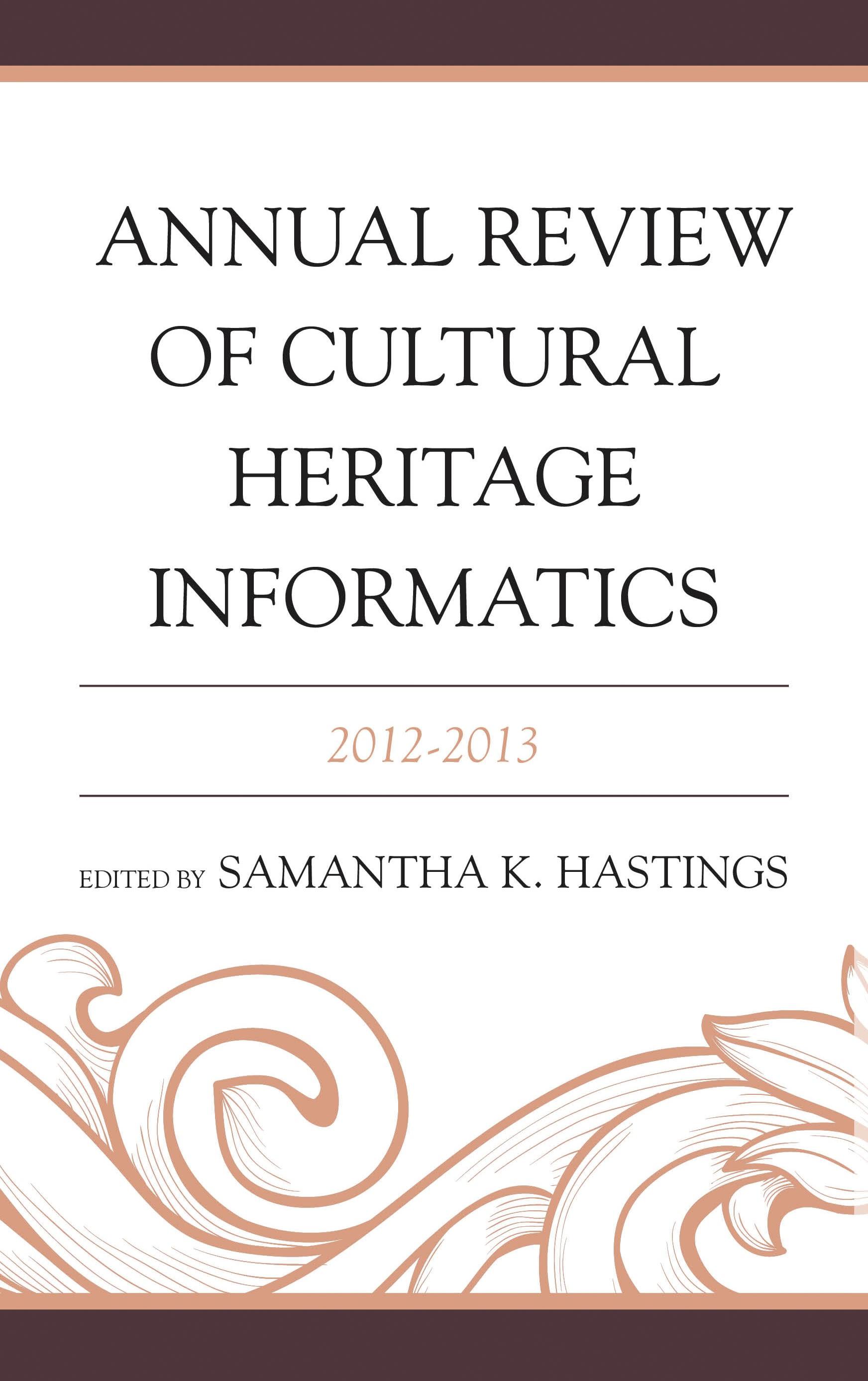
The premier volume of the Annual Review of Cultural Heritage Informatics (ARCHI), edited by Samantha Kelly Hastings, is the polestar publication for cultural heritage scholars, professionals, and students. Featuring sixteen original works selected by the distinguished editorial board of international scholars, ARCHI presents a broad spectrum of the cultural heritage informatics field. Whether one is interested in cultural heritage preservation, digitization, digital humanities, user behavior, technology, or educational practices, ARCHI is the central source for current and emerging trends in the rapidly expanding cultural heritage informatics field.
Major sections include Best Practices, Digital Communities, Education, Field Reports, and Technology:
• Best Practices contributors, such as distinguished scholars Michèle V. Cloonan, Martha Mahard, Daniel Gelaw Alemneh, Abebe Rorissa, Jeannette A. Bastian, and Ross Harvey, explore the increasingly converging, distributed, and pluralistic nature of digital cultural heritage and suggest new perspectives on traditional preservation and access methodologies.
• Digital Communities authors emphasize the role of cultural maps in interpreting digital representations and advocate for the preservation of digital cultural discourse.
• Education offerings include an exploration of a current cultural heritage informatics educational program and an analysis of educational resources available to local history and genealogy collection librarians.
• Field Reports case studies include active digitization programs, cultural heritage preservation initiatives, and developing cultural heritage research agendas in Ethiopia, Pennsylvania (U.S.), Australia, and Romania.
• Technology for promoting the accessibility and preservation of cultural heritage is explored from the specific perspectives of a digital humanities virtual reality application, identification of a metric enabling libraries and archives to invoke analog video reproduction rights under the United States Copyright Act, folksonomies and other social networking tools as finding aid extensions, and a review of digital collection user studies.
In addition to the five major sections, a nascent sixth, Reviews, section is introduced and the vision charted for its expansion in future volumes. Providing a compendium of current research, educational initiatives, and best practices, ARCHI is a pivotal resource for cultural heritage informatics scholars, practitioners, and students. By challenging readers to explore a variety of contexts and offering critical evaluation of conventional practices, ARCHI promotes new ideas and offers new pathways of development for the cultural heritage informatics field.
Major sections include Best Practices, Digital Communities, Education, Field Reports, and Technology:
• Best Practices contributors, such as distinguished scholars Michèle V. Cloonan, Martha Mahard, Daniel Gelaw Alemneh, Abebe Rorissa, Jeannette A. Bastian, and Ross Harvey, explore the increasingly converging, distributed, and pluralistic nature of digital cultural heritage and suggest new perspectives on traditional preservation and access methodologies.
• Digital Communities authors emphasize the role of cultural maps in interpreting digital representations and advocate for the preservation of digital cultural discourse.
• Education offerings include an exploration of a current cultural heritage informatics educational program and an analysis of educational resources available to local history and genealogy collection librarians.
• Field Reports case studies include active digitization programs, cultural heritage preservation initiatives, and developing cultural heritage research agendas in Ethiopia, Pennsylvania (U.S.), Australia, and Romania.
• Technology for promoting the accessibility and preservation of cultural heritage is explored from the specific perspectives of a digital humanities virtual reality application, identification of a metric enabling libraries and archives to invoke analog video reproduction rights under the United States Copyright Act, folksonomies and other social networking tools as finding aid extensions, and a review of digital collection user studies.
In addition to the five major sections, a nascent sixth, Reviews, section is introduced and the vision charted for its expansion in future volumes. Providing a compendium of current research, educational initiatives, and best practices, ARCHI is a pivotal resource for cultural heritage informatics scholars, practitioners, and students. By challenging readers to explore a variety of contexts and offering critical evaluation of conventional practices, ARCHI promotes new ideas and offers new pathways of development for the cultural heritage informatics field.
Pagine: 316
Categoria: Samhällsvetenskap
e-ISBN: 9780759123342
Peso di spedizione: 1.2 kg
Spedito in: 1-2 giorni
Paga facilmente con carta, Klarna, Apple Pay o Google Pay. Non sei soddisfatto? Hai sempre 14 giorni per il rimborso. Leggi di più nei nostri termini. Per qualsiasi domanda, scrivici a hello@memmo.org.
Memmo rende lo studio più facile, ovunque tu sia nel mondo. Qui trovi i tuoi libri di testo e strumenti di studio intelligenti, tutto in un unico posto: riassunti, quiz, podcast e flashcard. E poi c'è Ted, il tuo compagno di studio che risponde a ogni tua domanda. Oltre 50.000 studenti studiano già qui: è stato creato per aiutarti a imparare più velocemente e a stressarti meno.