
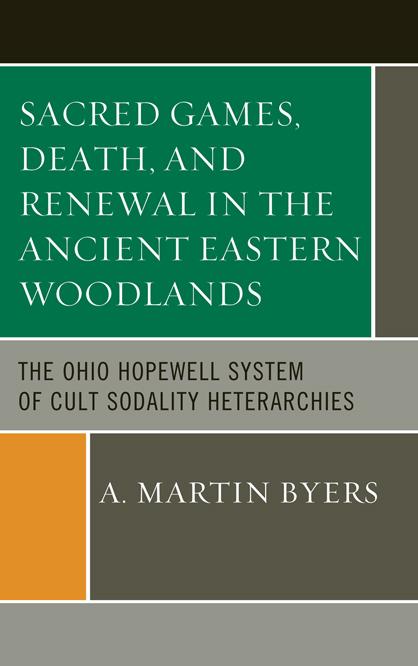
The book presents an account of the Ohio Middle Woodland period embankment earthworks, ca 100 B.C. to A.D. 400, that is radically different from the prevailing theory. Byers critically addresses all the arguments and characterizations that make up the current treatment of the embankment earthworks and then presents an alternative interpretation.
This unconventional view hinges on two basic social characterizations: the complementary heterarchical community model and the cult sodality heterarchy model. Byers posits that these two models interact to characterize the Ohio Middle Woodland period settlement pattern; the community was constituted by autonomous social formations: clans based on kinship and sodalities based on companionship. The individual communities of the region each have their clan components dispersed within a fairly well-defined zone while the sodality components of the same set of region-wide communities ally with each other and build and operate the embankment earthworks. This dichotomy is possible only because the clans and sodalities respect each other as relatively autonomous; the affairs of the clans, focusing on domestic and family matters, remain outside the concerns of the sodalities and the affairs of the sodalities, focusing on world renewal and sacred games, remain outside the concerns of the clans. Therefore, two models are required to understand the embankment earthworks and no individual earthwork can be identified with any particular community.
This radical interpretation grounded in empirical archaeological data, as well as the in-depth overview of the current theory of the Ohio Middle Woodland period, make this book a critically important addition to the perspective of scholars of North American archaeology and scholars grappling with prehistoric social systems.
This unconventional view hinges on two basic social characterizations: the complementary heterarchical community model and the cult sodality heterarchy model. Byers posits that these two models interact to characterize the Ohio Middle Woodland period settlement pattern; the community was constituted by autonomous social formations: clans based on kinship and sodalities based on companionship. The individual communities of the region each have their clan components dispersed within a fairly well-defined zone while the sodality components of the same set of region-wide communities ally with each other and build and operate the embankment earthworks. This dichotomy is possible only because the clans and sodalities respect each other as relatively autonomous; the affairs of the clans, focusing on domestic and family matters, remain outside the concerns of the sodalities and the affairs of the sodalities, focusing on world renewal and sacred games, remain outside the concerns of the clans. Therefore, two models are required to understand the embankment earthworks and no individual earthwork can be identified with any particular community.
This radical interpretation grounded in empirical archaeological data, as well as the in-depth overview of the current theory of the Ohio Middle Woodland period, make this book a critically important addition to the perspective of scholars of North American archaeology and scholars grappling with prehistoric social systems.
Paga facilmente con carta, Klarna, Apple Pay o Google Pay. Non sei soddisfatto? Hai sempre 14 giorni per il rimborso. Leggi di più nei nostri termini. Per qualsiasi domanda, scrivici a hello@memmo.org.
Memmo rende lo studio più facile, ovunque tu sia nel mondo. Qui trovi i tuoi libri di testo e strumenti di studio intelligenti, tutto in un unico posto: riassunti, quiz, podcast e flashcard. E poi c'è Ted, il tuo compagno di studio che risponde a ogni tua domanda. Oltre 50.000 studenti studiano già qui: è stato creato per aiutarti a imparare più velocemente e a stressarti meno.