
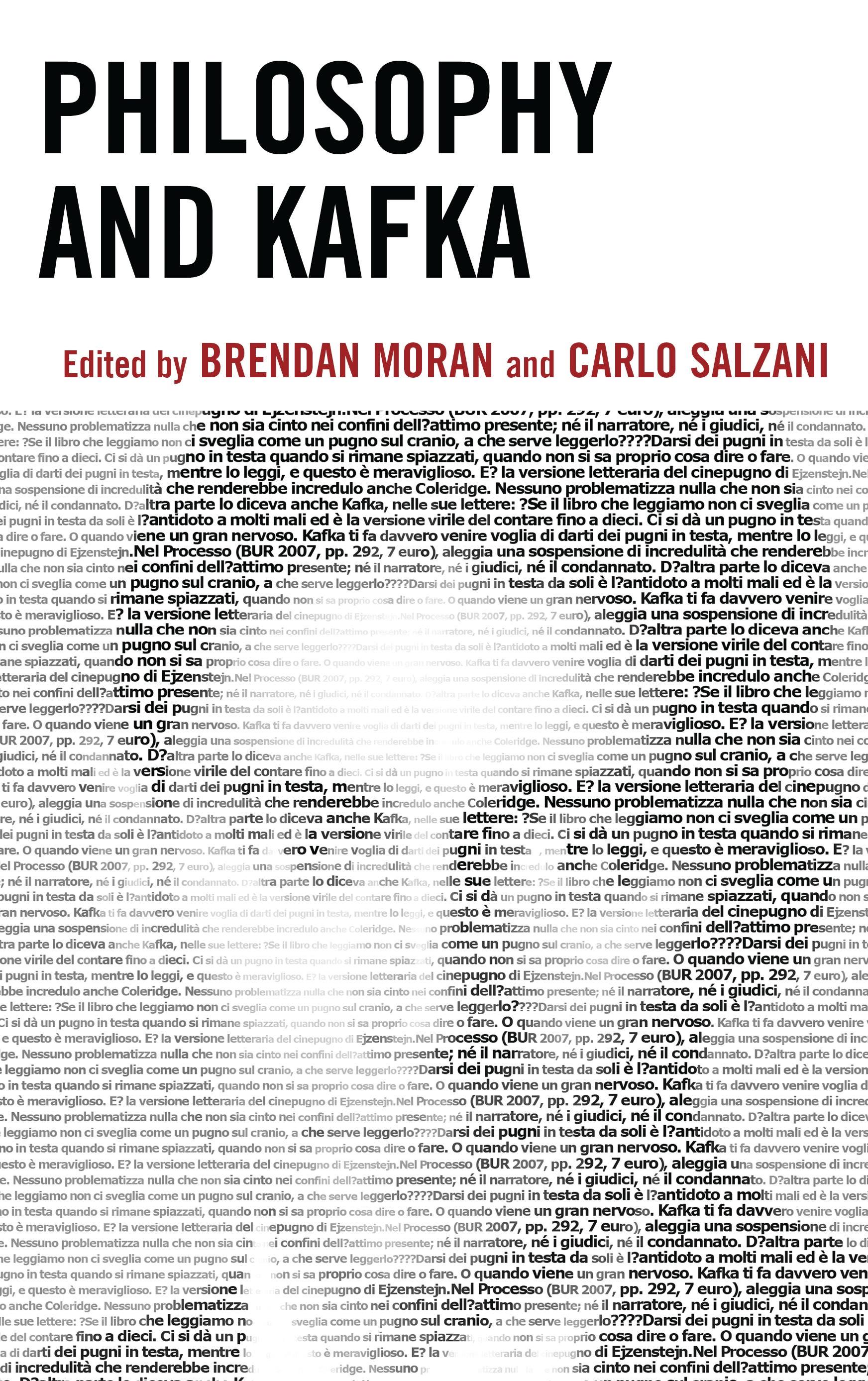
Philosophy and Kafka
Autore: Dimitris Vardoulakis, Brian O'Connor, Paul Alberts, Peter Schwenger, Brendan Moran, Carlo Salzani, Ronald Bogue, Chris Danta, Paul Haacke, Rainer Nagele, Andrew R. Russ, Kevin W. Sweeney, Isak Winkel Holm
Editore: Bloomsbury Publishing
Edizione: 1
Data di pubblicazione: 2013
ISBN: 9780739180891
The relationship of philosophy with Kafka’s oeuvre is complex. It has been argued that Kafka’s novels and stories defy philosophic extrapolation; conversely, it has also been suggested that precisely the tendency of Kafka’s writings to elude discursive solution is itself a philosophical tendency, one that is somehow contributing to a wiser relationship of human beings with language. These matters are the focus of the proposed volume on Philosophy and Kafka.
The proposed collection brings together essays that interrogate the relationship of philosophy and Kafka, and offer new and original interpretations. The volume obviously cannot claim completeness, but it partially does justice to the multiplicity of philosophical issues and philosophical interpretations at stake.
This variety informs the composition of the volume itself. A number of essays focus on specific philosophical commentaries on Kafka’s work, from Adorno’s to Agamben’s, from Arendt’s to Benjamin’s, from Deleuze and Guattari’s to Derrida’s. A number of essays consider the possible relevance of certain philosophical outlooks for examining Kafka’s writings: here Kafka’s name goes alongside those of Socrates, Kant, Kierkegaard, Nietzsche, Wittgenstein, Buber, Heidegger, Blanchot, and Levinas. Finally, a number of essays consider Kafka’s writings in terms of a specific philosophical theme, such as communication and subjectivity, language and meaning, knowledge and truth, the human/animal divide, justice, and freedom. In all contributions to the volume, such themes, motifs, and interpretations arise. To varying degrees, all essays are concerned with the relationship of literature and philosophy, and thus with the philosophical significance of Kafka’s writings.
The proposed collection brings together essays that interrogate the relationship of philosophy and Kafka, and offer new and original interpretations. The volume obviously cannot claim completeness, but it partially does justice to the multiplicity of philosophical issues and philosophical interpretations at stake.
This variety informs the composition of the volume itself. A number of essays focus on specific philosophical commentaries on Kafka’s work, from Adorno’s to Agamben’s, from Arendt’s to Benjamin’s, from Deleuze and Guattari’s to Derrida’s. A number of essays consider the possible relevance of certain philosophical outlooks for examining Kafka’s writings: here Kafka’s name goes alongside those of Socrates, Kant, Kierkegaard, Nietzsche, Wittgenstein, Buber, Heidegger, Blanchot, and Levinas. Finally, a number of essays consider Kafka’s writings in terms of a specific philosophical theme, such as communication and subjectivity, language and meaning, knowledge and truth, the human/animal divide, justice, and freedom. In all contributions to the volume, such themes, motifs, and interpretations arise. To varying degrees, all essays are concerned with the relationship of literature and philosophy, and thus with the philosophical significance of Kafka’s writings.
Paga facilmente con carta, Klarna, Apple Pay o Google Pay. Non sei soddisfatto? Hai sempre 14 giorni per il rimborso. Leggi di più nei nostri termini. Per qualsiasi domanda, scrivici a hello@memmo.org.
Memmo rende lo studio più facile, ovunque tu sia nel mondo. Qui trovi i tuoi libri di testo e strumenti di studio intelligenti, tutto in un unico posto: riassunti, quiz, podcast e flashcard. E poi c'è Ted, il tuo compagno di studio che risponde a ogni tua domanda. Oltre 50.000 studenti studiano già qui: è stato creato per aiutarti a imparare più velocemente e a stressarti meno.